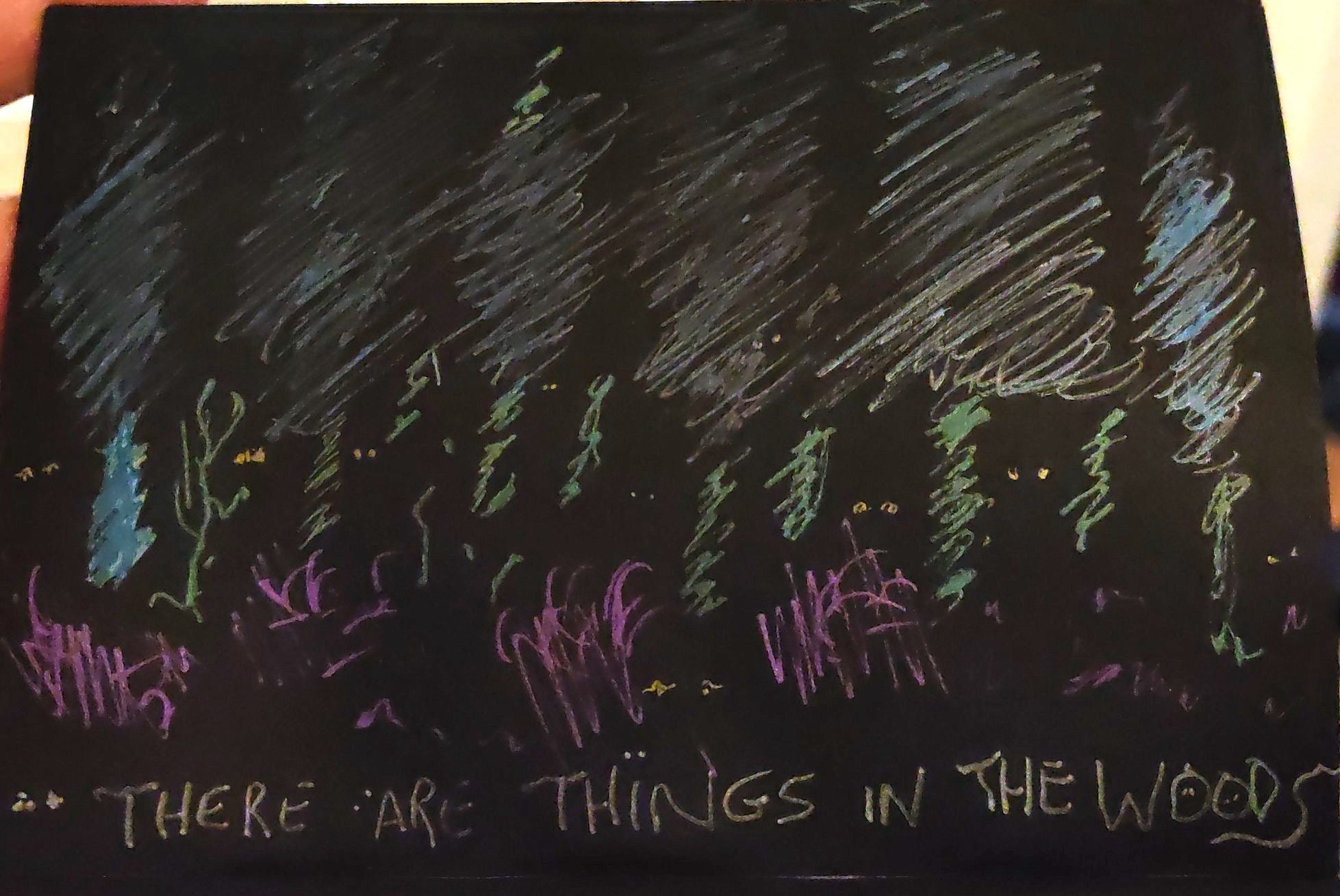
There Are Things In the Woods
by Thomas Pluck
There are things in the woods.
And I don’t mean squirrels.
Normally when you’re in the woods you can blame most unusual sounds on squirrels and chipmunks. Fast little buggers who like to skitter through the understory and make a ruckus much louder than their size would dictate, before disappearing behind a tree.
Where they probably emit a squirrel snicker into their little rodent paws while you look over your shoulder for whatever the hell that was.
When it’s not a squirrel, it’s a leaf.
What’s that weird shape with the color all wrong? A rare insect? A beautiful bird I’ve never seen before? A gobbet of decaying flesh?
No, it’s a leaf. Beautiful on its own, illuminated by a beam of sunlight through the trees, but not a jeweled beetle or a brightly plumed tanager or even a bushtit.
That’s my favorite bird name, which is saying a lot, because birds get the best names, like yellow-bellied sapsucker. See? Plus, bushtit has both bush and tit in it, which is enough to make my inner twelve-year-old snicker like a red-billed oxpecker any time it’s mentioned.
So, unexplained noises and sights in the woods, when they are too big to pass off as a squirrel or a leaf, are usually a bear. A black bear. Capable of climbing trees, standing on two legs, and scaring the hell out of people, because it is a bear.
Not everyone has the switch in their spine that flips to run when they see a snake, or a spider. But as apes who gave up swinging in the trees for walking on two legs a couple hundred thousand years ago, we never got over the terror caused by a big four-legged critter who thinks we taste like a honey-baked ham. And we shouldn’t. Black bears kill people every year, despite their peaceful reputation, which is only pacific in comparison to their enormous, murderous cousins, the grizzly bear.
“Peaceful compared to a grizzly bear” is a big ol’ caveat, in my opinion.
That doesn’t mean there aren’t garden-variety fools who won’t try to feed Yogi a granola bar. Some people also jump out of perfectly good airplanes. Or jump off bridges with rubber bands tied to their ankles. And eat wild mushrooms they picked, without identifying them with an expert.
I am not one of those people. I don’t skydive, I don’t feed the bears, and I don’t believe in Bigfoot, ghosts, or God, for that matter. Anything I haven’t seen.
Believers in the supernatural often ask me if I’ve ever seen a quark, the building blocks of the universe. (They used to say “atom” until electron microscopes came around, now they say “quark.”) And no, nobody’s seen a quark. But the science people show their work. The ghost people haven’t yet. And the God people never have. To paraphrase George Carlin, If you want me to believe there’s a man in the sky who loves me, but needs money, you’re gonna have to show your work.
But anyway, things in the woods.
If you’re in the woods, and you hear a noise or see something odd, or feel afraid, nearly a hundred percent of the time it’s either a leaf, a bear, or a squirrel.
Except when it isn’t.
It’s those times that haunt you.
When you can’t explain it.
Not to yourself, much less someone else.
You can’t explain it, but you can tell it.
Now, I’m not some hiker or camper who gets spooked easily. I work for the Bureau of Land Management, doing geological surveys. You ever find a brass marker set in the rock, in the middle of nowhere? They were put there by survey teams in the days before GPS. That’s one of the things we do. Charting the uncharted. Those markers are a measured distance from known landmarks.
Now we mostly do it using drones, with a laptop on the hood of a four-by on a fire trail, or sitting on a sun-warmed rock on an outcropping with the laptop on our knees and the controller in our hands. We still trek into the deep woods, because drones don’t fly forever—they need to be recharged—and sometimes they malfunction and crash.
And they’re expensive. The old men outside the coffee shop like to grouse about the government wasting their money, but if you lose something when you work for Uncle Sugar, you either find it or you have to fill out a ream of paperwork. And the higher-ups do, too. And the higher-ups don’t like filling out paperwork that makes them look bad.
So they send you after the drone.
Now, a lot of North America is far from unexplored, and most of the old growth forest has been cut down. The trees grew back, that’s what they do, but it’s second or third growth. Young. Pretty much every inch of the East Coast, from the tip of Maine down to the swamps of Florida, has been farmed or cut for lumber at one time or another.
Places that only an idiot would think was good for farmland, and spots only a desperate fool would want to drag out trees for lumber to build farms or ships, they were all scoured clean in the period after the colonists first arrived and drove the First Nations off the land, and a century or two later, when the Homestead Act sent them West.
But go in a little deeper, into the hollows where the folds of the earth make travel on foot treacherous for anyone unrelated to a mountain goat, and you’ll find hollows where old trees keep the understory dark in full daylight, where nothing on two legs has ever tread.
These are dark spots on the maps. Shadows in the highly detailed photos taken from the sky above. They’re not particularly weird or spooky. Places where light doesn’t go are dark. And drones lose contact for all sorts of reasons.
Once, one of my fliers got hit by a Cooper’s Hawk. I had to slow down the footage to see it coming, but it was fascinating to watch. Until I rewound and slowed it down, it looked like the drone just tumbled out of the sky. I had the last known coordinates, so we took a hike, and I found the busted drone, and we kept it for parts.
But this time, it was different. There was no hawk.
The drone is programmed to go into a holding pattern if it loses contact, kind of like navigating an invisible highway cloverleaf in the sky, as it tries to reconnect to the control signal. When the drone’s in sight, it’s frustrating. It’s like driving a car on ice. You’re turning the wheel but it’s not going where you tell it to go.
Usually the video goes out at the same time. Just goes black. Video takes a lot more bandwidth than the control data.
This time the video didn’t cut out.
I was just coasting along, at the speed required to capture good images, and the drone simply dropped out of the sky. It jolted me out of my chair, like it was me crashing through the trees, and not an expensive chunk of high-impact plastic.
The screen went dark.
Not black, but dark. I was still getting video. No audio, because when it’s flying, all you would hear is the motors.
The timer was advancing.
I stared at the screen, like I was trying to make something out in a lightless room. Patterns of pixels, different shades of black. Like it was in a patch of liquid shadow.
It had fallen into one of those dark spots on the map, where sunlight never makes it through the canopy to the understory.
I tried the controls again.
Nada.
“Well, that’s a new one.”
“What’s a new one?” Roberta, my co-worker, was sitting cross-legged on the tailgate of the truck with her laptop, monitoring her own drone.
“FGR-13 just dropped like a rock,” I said, and rewound the video.
“Lost another one? This will go on your permanent record.”
“They keep making us fly antiques, we’re gonna lose more.”
“Lemme see.” Roberta said, and hopped off the tailgate, stretching her legs. She wore a flannel shirt with the sleeves rolled up, over a gray long-sleeve t-shirt. Jeans and boots. Kind of our uniform. “Probably a bird strike.”
But there weren’t even turkey vultures out riding the thermals here.
“I caught a couple of mountain bikers making a porno last week,” she said. “Keary made me delete it.”
Keary was our boss, back at the office. He’d done field work, but now he handled the data and managed the team.
We watched it again. No feathers. Not even a wobble, which you’d expect if it had been hit by a flying missile. It went straight down. I played it back again, and whistled as it dropped.
“Battery went out.”
“I’m still getting video.” I pointed to the timer.
“Huh,” she said. “Malfunction.”
That’s not supposed to happen. The drones have four rotors, and can limp home on three. “Two rotors died? That’s a first.”
“It happens. They’re getting older,” Roberta said. “So are we. I’m going in for a colonoscopy next week.” She shuddered.
“TMI.”
“What? I’m not gonna show you the pictures. They gave me a gallon of gunk to drink the night before. And a whole pamphlet of instructions. It’s too bad they can’t send a drone in there, like Fantastic Voyage. Swallow a pill, find it later.”
I made a face. “That sounds worse.”
“Well, go get your baby. And don’t take too long. I need to get home and drink my Colon Blow.”
I turned on my pocket GPS, punched in the last known coordinates, and tracked out a path to the drone. It hadn’t been flying long, but it would probably take me at least a few hours to bushwhack my way to it and get back, if I could find it at all.
We had taken a fire trail cut by rangers as far as we could go, then jounced up a path so narrow it knocked the truck’s mirrors in, until the trees opened up into a bald spot on top of the nameless mountain, which gave a view of its sisters. In between the mountains were tree-choked valleys, visible from a spidery trail along the ridge lines, cut from outcrop to outcrop. Supposedly it had been a lookout in the French and Indian War, which meant it had been trod since time immemorial, if only as a way across land no one cared to inhabit.
I would take the ridge trail to an outcrop one mountain over, and then down a deer track to the valley, where I would find a way to the drone if I could. I set a timer on my watch, checked the battery on the walkie-talkie, slathered myself with tick repellent, and headed out.
It was a good spring day. Warm in the sun, jacket weather in the shade. The birches had put out buds and I cut a green twig to chew on as I hiked. They taste a little like birch beer. Like root beer, but minty, not so sweet.
The sky was a crisp blue, but it quickly disappeared as I followed the trail down. There were plenty of sparrows chirping, and squirrels and chipmunks rampaging through the leaf litter, even if the sky was bereft of raptors looking for meals.
Every forest has its background music. Some are more pleasant than others. Spring peeper frogs make a constant noise every season but winter. It sounds like it comes from everywhere, and it feels as regular as hearing your own heartbeat.
We’d mapped parts of the Pine Barrens for a gas pipeline project a few years ago, and a drone crashed into a swamp that wasn’t on the maps, because no one had reason to go there. From the sky, it looked like the rest of the pine forest. But the muck was knee deep, and the weeds too thick to paddle a canoe. We joked that the drone was taken by the Jersey Devil.
That was funny until we had to make our way back, trudging through the fine sand just beneath the pine needles, and the spring peepers silenced their song, all at once.
A great-uncle of mine had tinnitus. He’d lived with a constant ringing in his ears for decades. You’d think it would drive you mad, waking up with it one day, but he suffered in silence, or suffered in the lack of silence, for most of his life. If he went to a doctor, he never mentioned it. I only knew about it because at the wake of a distant cousin, he told me about it when we stepped out for a smoke in the funeral home parking lot. He said he sneezed real hard that morning, and the ringing went away.
Now, you’d think this would be a blessing. But he thought he was dead. He’d become so used to that noise, that it was like his heartbeat had stopped.
That’s what it felt like in the Pine Barrens when the frogs stopped peeping.
We halted dead in our tracks and looked around, like the frogs knew something we didn’t.
It was eerily quiet, deep in the barrens, the way the bed of pine needles on sand absorbs all sound, how the waters stained tea-brown with dead leaves are still and bright as crystal, and the pines stand tall and silent like ancient sentinels.
Roberta and I traded a glance. The only sounds were our own breath.
Then the silence was broken by the flapping of wings, and a huge dark shape was visible through the trees.
“Sandhill crane,” Roberta said, exhaling deeply.
Gray and large, it coasted to the other side of the swamp without a cry.
The frogs piped up. The predator had passed.
In my uncle’s case, he clapped both ears like he was a paramedic pumping someone’s chest. The ringing came back, and everything was all right.
But for us, we thought about that silence, and how in that moment, we felt like the drone before the hawk strikes. The frog before it is speared by the bill of the heir to the dinosaurs. Like our hearts had stopped.
The minty taste of birch had left the twig, but I chewed anyway. My GPS beeped as I neared the waypoint that I marked on the trail that was nearest to the coordinates of the drone. I kept walking, ducking branches, until I found a trail downhill into the valley where the drone had landed.
It was barely a goat track. More like where water spilled down the mountain in heavy rainfall. Pebbles collected at the side of small trees, which made for footholds.
I looked down into the heavy tree cover, and tried to visualize the spot where the drone had crashed. The GPS said it was 453 feet away, but that didn’t account for drops in elevation. There's a country mile, and there's a woods mile. This was less than a tenth of a mile, but bushwhacking, it could take hours. I checked my watch. I'd made good time.
I listened to the background music of the forest. It had become quiet, but not too quiet. The rustling of leaves, the trees touching fingertips as they swayed in the breeze, the alien song of insects enlivened by spring warmth.
I dropped a waypoint and began to sidestep down the mountain, toward the first foothold, holding branches and saplings to steady myself as the woods swallowed me up.
The woods weren’t that thick yet, and I was thankful. I had on the oily nasty deet, the strong stuff, but when ticks and chiggers haven’t sensed warm flesh in a while, they seem to find you no matter how well you tuck in your shirt and pant legs.
I monkeyed my way down the decline and found some ground that was somewhat flat, and zig-zagged beneath the branches. There was a soft bed of bark litter from the sycamores, some of which rivaled the Buttonball Tree in Sunderland, Massachusetts,, which claims to be the largest tree east of the Mississippi. Which is a bold claim, as not far away in Connecticut, there’s a wider tree called the Pinchot Sycamore.
What can I say, I like trees. I started in the forestry service, but I’m handy with computers—I’ve been using them since me and my pop built an Altair 8800. You couldn’t do much with it except flip switches and look at numbers on the display, but that was instant gratification for me compared to the punch cards he used at work. I bought an Apple II with my paper route money, and I’ve been staring at green screens ever since.
There was a game called Zork, all words, where you started off in a forest outside an abandoned house, which had a basement that led to a huge underground empire full of puzzles and trolls and treasure, and when Mom got sick of me tip-tapping away at the keyboard and told me to go outside, I pretended that the woods behind the development contained the house from Zork.
The closest I ever found was a tree house littered with older kids’ porno mags and empty cans of Schlitz, but I never stopped exploring the woods, identifying the different types of plants and insects and cataloging them on a program I wrote in Apple BASIC, and eventually, I majored in botany and minored in Comp Sci—after a big argument with Pop, who said it should be the other way around—and I headed into the woods instead of the halls of MIT.
They don’t take legacy, but I would’ve fit in there as long as I could explore the local woods looking for Lovecraft’s inspirations instead of the basements and tunnels that inspired the programmers who wrote Zork.
It is pitch black. You are likely to be eaten by a grue.
That’a a line from the game, and you never find out what a grue is. It’s just some thing in the dark that eats you if you take more than a few moves without a light source. But nothing scared me more than what a grue might be.
Imagination is the best painter. That’s why I loved those text games.
Nowadays video games look like the movies, and movies look like video games, but none of it scares or inspires me.
It’s so real that it looks fake to me.
The woods got thicker, with a rusty undergrowth poking through the sycamore litter like wispy red hairs. My boots crunched them down as I followed the arrow on the GPS, watching the distance meter shrink. You don’t get great signal in valleys, but if I could get close, I might be able to use the remote to spin the rotors and make some noise. But I’d have to get much nearer.
The air smelled peppery and the soft forest bed absorbed a lot of the sound. Not a lot of light made it through the canopy, and if clouds rolled in I would need my pocket flashlight.
The signal pointed into thicker undergrowth, so I pushed my way through, running my fingers through my hair in case I picked up any ticks. I had to do-si-do around a beech and hop over a silent brook that could’ve been standing water that meandered through the spicebush.
I left a marker for the stream, which wasn’t on the topographical maps. I followed it for a while, getting closer to the waypoint, and superimpose my track on the maps to mark the water. I was less than a hundred feet from the drone coordinates now. I dropped a mark at every turn and looked at my path on the GPS screen. Jagged like the teeth carved into a pumpkin.
Thumps and rustling leaves broke me away from the screen. Too big to be a squirrel.
And much too graceful. Flashing moss brown and white.
A herd of fat whitetail deer bounded through the trees with speed and agility I wish I could borrow, barely touching the branches. Like dolphins in the green surf of the forest, their hooves cut the dirt and made less noise than the blustering tree rats. I caught a glimpse of antlers but couldn’t count the points. But there were enough to excite a hunter.
The deer made the thinnest bit of trail, and I followed it.
I forgot, sometimes it’s deer. They usually don’t spook you, because it’s them that’s spooked. They make you feel like the bear in the woods.
And usually, humans are. Even before we had guns.
We’re what’s called a persistence hunter. Built for long-distance trekking, and most animals aren’t. We defeated them by tracking them and not giving up, not letting them rest.
That’s pretty terrifying, when you think about it. Something that follows you forever.
The path squeezed to nothing, and I was at the mercy of the GPS signal. I was within thirty feet now. The ground was thick and spongy with moss, and that earthy smell you get after a fresh rain. When I was within twenty feet, the digital arrow started spinning.
I dropped a marker—for what good it would do, with accuracy lost—and pocketed the GPS. I took out the remote for the drone and played with the controls, to see if I could hear the rotors.
The only sound was my own breath.
Nothing to do but kick through the undergrowth. I walked in what I thought was a circle, in big sweeping steps, like a kid playing the giant in the beanstalk story. All I kicked up was forest debris. No birds chided me for making a ruckus.
I took out the GPS to see if it had gotten a better signal.
The arrow mocked me, spinning in a slow circle.
I took out the walkie talkie. These used their own radio band and were good at bouncing off the hills to reach each other.
“Hey, Berta,” I said into it.
My voice felt very loud. I couldn’t even hear the leaves touching each other. The day’s breeze didn’t reach down here.
The forest embraced me in an eternal twilight. Fat bolete mushrooms, the kind that grace fairy tale illustrations and psychedelic album covers, poked up through the decaying leaves and branches and dotted the moss.
Among them, white saplings that looked bleached of color, which had died grasping for sunlight they could never reach. Thin white hairs peeked out of the moss like tiny fingers wriggling through.
In the dim light, they looked like peach fuzz on a child’s arm, almost a glow. Not sure if they were iridescent and affected by the tiniest rays of light from above, but I thought I could see waves over them, messages running back and forth. Almost like they were moving.
I found myself twiddling with the drone remote, listening to my own breath. Feeling like we had in the Pine Barrens, right before the crane shattered the silence.
Something buzzed. Thppp, thppp.
The drone!
I thumbed the controls to make it ascend. A distant buzz, like a weed trimmer. I followed it, tapping the sticks.
The remote in one hand, GPS in the other. Every once in a while, the arrow snapped sharp north. The ground seemed to swallow my boots. They made no sound, like I was walking on a big pillow.
I stomped the moss.
It made no sound.
I could barely hear my own breathing.
I wiggled a pinky into my ear, and I could hear that. So, ticks hadn’t infested my eardrums.
I exhaled loudly.
It felt very close, like I was a little kid hiding under the blankets. Like I’d been swallowed up. My heartbeat thumped in my ears.
I felt like a little frog in the woods, and the trees were the legs of a giant marsh bird, ready to spear me.
The crackling of the radio might as well have been thunder.
“You on your way back?” Roberta. Distorted, but there.
I gasped and fumbled for the walkie talkie. “No, I lost GPS signal. I’m gonna backtrack, but I’m so close. Are you still getting video?”
“I thought it was just a blank screen.”
“I did too, but the timer was running. Take a look.”
I retrieved the remote, then stepped on a big mushroom to leave a marker, and tried to backtrack my steps in the moss while she went to my laptop.
I held the GPS high, like a few feet would make a difference.
“Something is moving,” her voice crackled.
“The remote’s working again. I’ve been following the sound.”
The canopy made it dark here, and beyond the edge of my vision, the gloom seemed to move, like oil on the top of a cup of black coffee.
Thppp, thppp. The drone buzzed.
Except I hadn’t touched the controls.
“Get out of there!” Roberta shouted.
I got that bear-tingle in the base of my spine. My legs moved without me telling them to.
I ran blindly through the trees, away from where I’d been headed, the walkie talkie in one hand, the useless GPS in the other. All I could think was that I must have sounded like a giant, terrified squirrel dashing for the safety of a tree.
Except all I could hear was my own panting as my arms slashed through the leaves.
I bounced off a rotten trunk and tumbled into the moss. Looking up, the underbelly of the forest was as dark as the laptop screen had been. Like the living darkness you see when your eyes are closed.
“This is like the Pines,” I panted into the walkie talkie. My breaths began to run into each other. I started to blink, to see if I could tell the difference between my eyes being open or closed. “I can’t hear anything.”
The silence in the woods was a living thing. A smothering thing that fed on sounds. I tried to quiet myself like the frogs had, but I had just sprinted through the woods, and my lungs wouldn’t obey. I covered my nose and mouth with my sleeve, but each breath felt lesser, like something was drinking it up. Like I was sinking into the moss.
I once got a morphine shot at the hospital, for a kidney stone. I remember feeling like I was slowly falling through the bed, as the drug took effect. The cold moss felt as comfortable as that warm soft bed.
A sharp crack echoed off the trees.
“I fired a shot,” the radio sputtered “Run towards the shot!”
I clambered all fours, gasping in a deep breath. The air felt thick.
Another crack. Behind me. I turned and stumbled that way. The dim light from the GPS was my green screen now. The arrow wavered back and forth like a fish in a lazy stream.
“I hear you,” I croaked into the radio, and Roberta fired again.
I tripped and splashed into the jagged stream, falling onto my elbows. Face first with splayed tracks of deer hooves in the black dirt, and the blackberry pine cones of their scat.
I wouldn’t have been happier if I’d burst into the white house from Zork.
The GPS behaved again, and I followed the toothy track back up the hill. Roberta waited for me on the logging trail, her pistol in one hand, the radio in the other.
“You keep that for bears?” I said.
“Yeah,” Roberta said, and holstered it under her flannel shirt. “Bears.”
She wouldn’t tell me what she saw on the laptop. She just said it looked wrong and she freaked out. But wasn’t I glad she was packing?
As Roberta bounced us down the trail in the truck, I was disappointed that I hadn’t recorded the video.
Maybe I would have captured footage of a grue.
That night, after a long hot shower and a thorough tick check, I was thankful that I didn’t have the recording to play over and over again.
The memories in my head were enough.
Sometimes as I lay in my bed, on the moonless nights so dark I can’t tell if my eyes are closed or open, my breathing starts to feel close.
Like the walls are thick with moss, writhing with white fingers reaching through the liquid shadow of the dark.
On those nights, I know there are things in the woods.
And I hope they didn’t follow me home.
—
© 2022 Thomas Pluck