This story first appeared in Protectors: Stories to Benefit PROTECT, my anthology to support The National Association to Protect Children. I wrote it as a homage to both the American roots music revivalist John Fahey and to author Manly Wade Wellman, who wrote the John the Balladeer tales that evoked Appalachian folklore.
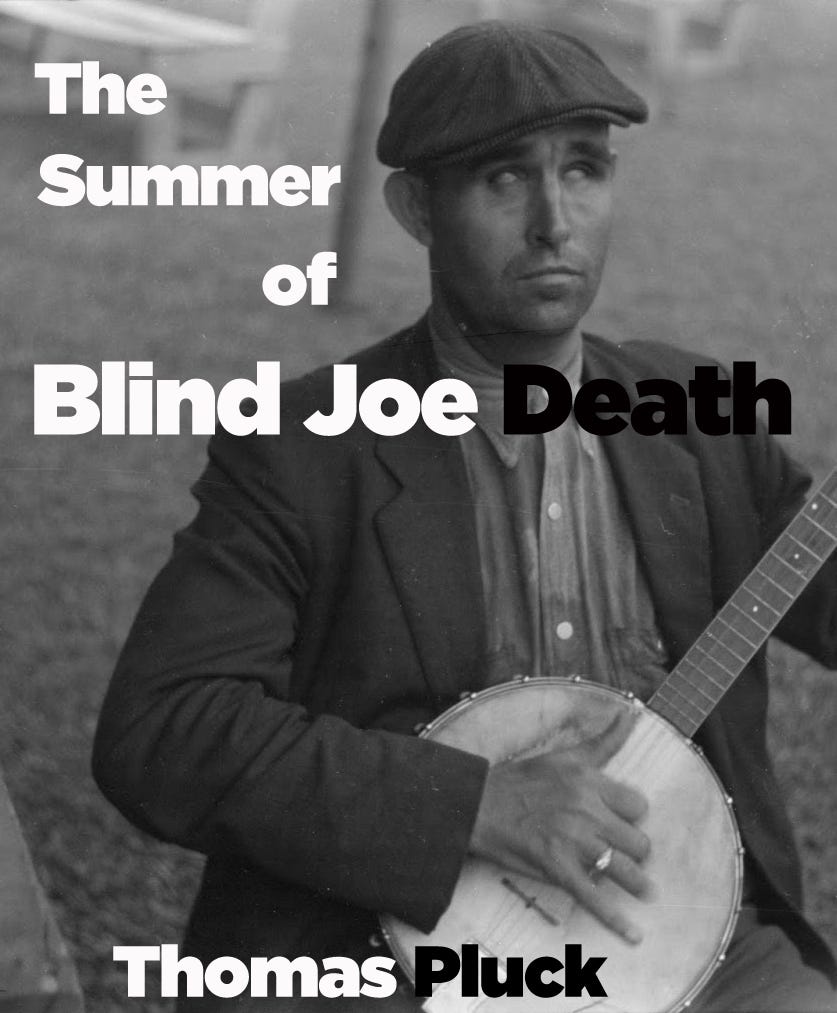
The Summer of Blind Joe Death
The worst summer I remember was when I turned nine years old, and Blind Joe Death came through the holler, strumming a silver-stringed guitar made from a baby’s coffin.
We’d lost my Paw in the mine collapse the year prior, which put me in charge of putting meat on the table. That morning I lit out with Paw’s varmint rifle on my shoulder, and Shuck, my blue tick coonhound, by my side. It was a great day to be a boy, with the sun fighting through the leaves, and the birds singing their hearts out, and three fox squirrels in my tow sack.
I thought any day in the woods with Shuck was a great one, but I was about to learn otherwise.
I’d met my best friend, Red Collins, at the swimming hole, and we walked home together along the mountain road.
“You want to look for arrowheads before supper?” I asked.
“Sure, long as I get my chores done,” Red said. “I’d like that fine.”
Red was about as lanky and freckled as a daddy longlegs with the measles His left eye had a gray shadow of a goose egg underneath. I didn’t ask about it. I knew where he got those from.
We dodged a coal truck barreling down the mountain, and the ground trembled long after it passed, like a hungry man’s belly. Last year, it had swallowed my Paw whole. I imagined him still trapped down there sometimes, swinging a pick to dig his way out.
As we neared the crossroads, Shuck whimpered deep in his throat, and wouldn’t budge.
“What’s got into you, boy?”
Red stared up the road. “You believe in haints, Wade?”
“Never seen one,” I told him, “but that don’t mean they ain’t there.”
The woods in Shockey’s Hollow are dark and thick, and the old folk tell of ghost Injuns leering through the trees. My Grandma told tales of the Wendigo, so hungry and skinny you can only see it from the side, and the Behinder, that no one’s ever seen and lived. When I was deep in the woods, the Behinder, or something like it, would make the hairs raise on my neck.
I had that feeling then, and my feet would neither walk forward, or run away. I was thinking maybe to panic, when we heard a well-deep voice on top of strings that tingled like a pocketful of silver dimes. I couldn’t place where it came from, like the singer was trapped down in the mine with my Paw and his crew.
The sun is on fire, and the moon is a liar
But darling I’ll tell you one thing that is true
Wherever I wander and wherever I roam
The smile on your face is what I’ll call home
Red and me sat as dumb as two coal buckets as the guitar player rounded the corner. He looked like a scarecrow that had hopped off his cross, looking to eat a few ears of corn himself. He wore a shapeless hat mashed on his head, dusty boots and an ice-blue pair of overalls, worn threadbare at the elbows and knees. He picked a square, black guitar that hung from his shoulder on a leather strap. His fingers danced on the bright silver strings.
“Good afternoon, boys,” the singer said. He wore spectacles with smoked lenses, and looked pale as death eating a cracker.
“You play fierce pretty,” I said.
“Reckon I’ve been playing long enough that if I didn’t, I should hang myself and be done with it,” he replied, and a smile full of small grayed teeth spread across his face. “Name’s Joe.”
“That’s Blind Joe Death,” Red whispered, and froze.
“That’s what they call me,” Joe said, and scratched Shuck’s ears. “Once, it was just plain Joe. Then Blind Joe, when I lost my sight.”
“Why don’t you wear an eye patch, like a pirate?” Red asked.
“I’d have to wear two of ‘em,” Joe said. “I’d look right foolish, don’t you think? And I can see some, when the sun’s down. I usually walk at night.”
“Ain’t you scared of haints and such?” Red asked.
Joe held up his guitar by the neck. “My playing must frighten haint and beast alike, for I’ve never met nothing in the dark that’s scarier than what hides in the light.”
The thought of him strumming his guitar in the nighttime gave me a shiver. Shuck nudged my side, and kept his head low.
“It’s all right, boy,” I said, and rubbed Shuck’s neck.
Joe tilted his head and let the sun hit his face, blue veins showing through the skin. “You boys know anyone who might trade the listen of the old music for a little supper?”
“My Maw’s making Brunswick stew, Mister uh, Death,” Red said.
“Just Joe,” he said. “And what should I call my new benefactors?”
“I’m Wade, sir,” I said.
“My name’s Asa Junior, but everyone calls me Red.”
“That’s all right, Red.” Joe said, strumming up a tune. “My name’s Joseph, but everyone calls me Blind Joe Death.”
He followed us home and played “Frog, He Went A-Courting,” with Shuck howling tenor to his bass. “That’s some fine accompaniment,” Joe said. “What do you call this pup?”
“That’s Shuck, my hound dog.”
“Best dog in the holler,” Red said.
Joe strummed as he talked, answering the birds that chattered in the pines. “He wouldn’t be named after Old Black Shuck, would he?” he said.
“Yup,” I said. “My Grams taught me about Old Shuck.”
Joe picked low notes, and his dirge shivered my backbone.
Old Black Shuck, the charnel hound,
don’t be howling at my door.
I left a plate of meat and bone,
to keep you on the moor.
Shuck whined and tugged at my pants again.
“He finds that tune too familiar.” Joe laughed, and resumed his livelier picking. “Reckon I could set with your grandmother after supper? The old folks know the old music.”
I looked down at my shoes, as we walked. “She’s done gone to the other side.”
“Sorry to hear that, Wade. Reckon I’ll set with her soon enough.”
Grams would rock her chair and gum her clay pipe, and her eyes would go far away. “Old Shuck roams the mist between our world and the next. He’s big as a pony, and black as a starless night. With two eyes of yellow fire, and a howl that turns a brave man’s legs to water.” She poked my arm with her pipe stem. “Whether your time’s come or not, if you hear Black Shuck bark three times, you don’t see the sun in the morning.”
Red slouched as we neared his family’s rocky patch of land, which had never seen a plow’s blade. Their bony milk cow, Millie, had the roam of it. She left her flops on the path to the door, then stood chewing her cud, waiting for you to step in one.
Red’s Paw liked nothing better than to set on the porch with a jug of shine, and that’s how we found him. He stared out at nothing, slumped in his crooked chair with an uncorked jug of lightning dangling from one finger, his eyes as mean as a striped snake’s.
“Good afternoon sir,” Blind Joe said, and finished the tune with a flourish. “My name’s Joe, and I play the old songs, and some new.”
“He plays real fine, Paw. I thought maybe he could have some of my stew tonight, so we could hear him play.”
Mr. Collins squinted, like he wasn’t sure we were real. “You come begging at my door?”
“No, Paw--”
“Quiet, boy,” Collins said, and raised his hand.
Red flinched and looked down. “Yessir.”
Mr. Collins laughed and slugged back a wallop of shine. “Look around, beggar man. It’s hell’s half acre. You want something to eat, there’s some corn cobs in the outhouse, might be a few kernels left on ‘em.”
“But Paw, he’s blind,” Red said.
Red’s Paw wrinkled his nose. “You’re that hoodoo man, ain’t you?” he said. “The one who went plumb berift and clawed out his own peepers, when his woman died crapping him out a child.”
Joe’s face went flat.
“Take your cursed self off my land,” Mr. Collins said, and spat at Joe’s feet. “You come back, I’ll spit in your two empty eye holes.”
“I’ll see you after supper, Red,” I said.
“Bringing a filthy beggar to our house?” Mr. Collins slipped his belt from its loops, and wrapped it around his hand. “To eat the food I slave to put on your plate?”
Red held out his tow sack. “I caught a mess of frogs,” he said. “We can have frog legs.”
“Ain’t nobody’s business what we eat!”
“But you said you like ‘em--”
“Don’t you sass me, boy!” Mr. Collins struck out with the belt. I winced, but Red didn’t flinch or cry. His maw peered out the window, all sunken eyes and stringy hair. She gave a jagged grin, and set her elbows on the sill.
Mr. Collins took Red by his collar, and lashed the belt buckle back and forth across his face. Snot and blood ran from Red’s nose, and his Maw cackled at the show.
Joe’s fingers danced over the guitar strings like two white spiders.
Red-haired Mr. Collins, what makes you so cold
You whip your boy for being kind, don’t that seem strange to you
You kick the friendliest dog enough, and he’ll take a bite of you
Shuck pulled away from me, and bolted up the porch to bark and snap. Mr. Collins kicked him in the ribs, and sent him tumbling into the weeds. Shuck leapt right back and chomped the belt. Shuck pulled hard, and Mr. Collins lost the of tug o’ war. He stumbled off the porch, and fell face first into one of Millie’s runny cow pies.
Mr. Collins yelped and pushed himself away. Shuck clamped his jaws on the back of his neck, and growled deep and low.
“Easy, boy.” I said, and Shuck backed away slow, baring teeth.
Mr. Collins wiped the mess from his face, and Joe laughed. “I can’t see, but I can smell what happened.”
“No one crosses me, who don’t live to regret it,” Collins seethed. “You remember that, blind man, and you too, Wade Gibson.”
“C’mon, Red. You can sleep at my house.”
“Boy, you got to come home some time,” Mr. Collins said. “Ain’t no dodging what you deserve. That’s how it was for me, and that’s how it is for you!”
We hurried to the road, while Mr. Collins cursed and stomped Red’s tow sack. I felt bad for the frogs. We heard him cussing a long ways down the road.
Red sniffled, his jaw set with pride. He wiped his face on his sleeve, and picked up a knotted stick to swat the weeds. “I’m sorry, Joe.”
“Nothing you done,” Joe said, tuning a string.
“It’s the moonshine does it to him,” Red said. “He’s almost nice in the morning, some times. If he ain’t drank too much the night before.”
The Muntz boys ran the shine in our holler, and anyone fool enough to complain had the tendency to disappear. My Paw used to take a sip when offered, but never kept a jug in the house. He said you buy enough jugs of shine, and they’ll own you.
“Me and Paw built a new hen coop for the preacher last week,” Red said. “He didn’t sneak nips of shine or nothing. He said I did a halfway good job, and that felt right fine.”
“I heard Preacher say how much he liked your work,” I said.
“If I knew where those stills were, I’d blow ‘em all to hell,” Red said, and whipped the stick at the wind. “We should go looking for them. Bet we’d be the heroes of half the holler.”
“I’m not so sure of that,” Joe said, picking out a new tune. “And you boys ought not to mess with the Muntz clan. They’ve made the mountain dew since I was your age, and they’ve put plenty of men in the ground.”
I like beer when it’s far or near,
And I like bourbon whiskey
But a man who’s wicked in his cups
His kind I find too risky
A happy drunk’s a lucky skunk
He has friends in ary holler
But a man who’s wicked in his cups
I find him hard to swaller
Maw stepped out on the porch as Joe sang us in. She had her hair tied back, and a wooden spoon in her hand. She stared at us and crossed herself.
“Hi Maw,” I said. “Can Joe stay for supper? He plays real fine.”
“Ma’am, it would be my honor to play the old music, and break bread with you.” Joe jumped into another song before she could respond.
Coffee grows on white oak trees
Rivers flow with brandy
I’ve got a pretty little blue-eyed gal
Sweet as molasses candy
Joe strummed a flourish and bowed so deep I thought he’d break in half.
“Is that you, Joe Fahey?” Maw said.
“I’m just Blind Joe now, ma’am.”
“It’s Silphy Gibson,” Maw said, and squeezed Joe’s hand. “I haven’t seen you since my wedding day.”
“When you married Jeffrey. Where is the lucky feller?”
Maw winced, and I looked at my feet. “He died in the mine collapse last year,” she said. “But he always spoke kindly of you.”
Joe frowned. “I’m real sorry to hear of his passing,” he said. “He was a good man.”
I held up my tow sack. “Me and Shuck got three squirrels, Maw.”
“Well skin them up, and we’ll have a stew.”
After supper, we sat on the porch to hear Joe play. Red and me clapped and sang along to the jaunty tunes, and Maw sang the slow ballads. As the sun’s red blaze dipped behind our mountaintop, and the jar flies buzzed their last racket of the day, Joe came to a song that made Maw close her eyes, and sing real sweet. It was one Grams used to hum to herself, and Maw’s voice rang high over Joe’s mournful tones.
That was the first time I realized how beautiful my mother was. Not just to me, but to other people. The last note faded, and Maw finished the chorus alone.
Slumber, my darling, and I’ll keep you warm
Through the chill of the evening, and the blow of the storm
For the child that we cradled, and the love in our hearts
I’ll wander these hills ‘til we’re no longer apart
Maw cleared her throat when she caught us staring. “That’s a fine old song,” she said.
“Thank you, ma’am,” Joe said. “Ain’t heard a voice so pretty in a very long time.”
“Thank you, but that can’t be true, with your travels.”
“Upon my honor,” Joe said. “Only voice sweeter is one I’ll never hear again. And I’ve roved these mountains north to Maine, and down to Georgia.”
“Why’d you do all that wandering?” I asked.
“Just something I set myself to do.”
“How’d you go blind, Joe?” Red asked.
“Red Collins,” Maw said. “You know better.”
Joe aimed his blank lenses at each of us in turn, then unhooked them from his ears. His eyes were black as two wet river stones. “I can see some, in the gloaming. I can tell Shuck’s a blue tick. And that Wade’s gonna catch flies, he don’t close his mouth.”
I shut my mouth, and waited for him to answer Red’s question. Joe blinked at the stars, as if getting his bearings. Then he tucked his glasses in his shirt pocket, and stretched with a creak. “Reckon it’s time I move along,” he said. “Thank you folk, for the best meal I’ve had in a dog’s age.”
“Oh Mr. Fahey, let us fix you a pallet,” Maw said. “It’s almost dark.”
“Thank you Miss Silphy, but these old bones sleep under no roof when the ground is dry.” Joe adjusted the strap of his guitar.
“But there’s haints out there,” Red said.
“And the Behinder,” I said.
“Who’s been putting them tales in your heads?” Joe laughed. “Besides, if any of them try to spook me, I’ll play this.” He scraped a fingernail down a string, and his guitar gave a tinny shriek that made us wince, and Shuck whimper.
“Maybe I’ll see you on my way back through the holler,” Joe said, and began picking. We bid him goodnight, and he disappeared down the road, singing to the sky.
Silphy, O Silphy, sing us a song
The sweetest pure voice I’ve heard in so long
Shuck’s a fine coonhound, best in the state,
And you cook the best squirrel I ever ate
His song joined the night sounds of the forest, and soon we couldn’t tell what was crickets and owls, and what was Joe.
“That poor, poor man,” Maw said, and shook her head.
“Do you know how he went blind, Mrs. Gibson?” Red asked.
“Joe was orphaned by the War between the States, is what I was told,” she said. “He’d sing for his supper, and he was the best guitar player we’d ever heard. When he came of age, he courted Vandy Wellman. Prettiest girl in the holler. Her folk didn’t like it, but her Paw gave in, eventual.” Maw smiled. “She was so in love. And back then, Joe was a handsome man.”
She rubbed her tired knuckles a while, before going on.
“Way I heard it, when she was with child, a man from Washington came through the hollers, looking to hear the old music. Said he was saving all the old songs in a museum, on his record machine. Joe didn’t want to leave her, but Vandy urged him on until he gave in, kissed her goodbye, and hurried down the mountain.”
“The other musicians were green with envy,” Maw said. “For Joe’s talent, and his bride. They sent him on a snipe hunt all over the state, and by the time Joe realized he’d been fooled, the museum man had already gone back to the city, and lugged his machine with him. When Joe made it home, Vandy was sick with fever. He ran for the doctor, but she died giving birth.” She shook her head, looking up at the growing moon.
“What about the baby?” I asked.
“Went to heaven with her,” Maw said.
“But how’d Joe go blind?” Red said.
“Rumor is, Joe played three days and nights, begging the Lord to bring her back. And when he got no answer, he played to the devils and the haints, any spook that would listen, cursing the clear blue sky. A bolt of lightning struck his guitar, shattered it to flinders. Struck Joe blind, and made him white as death.”
Me and Red stared. I counted the times we’d said the Lord’s name in vain.
“But that’s just talk, boys. Don’t y’all be scared now. I’m plumb crazy, telling you that tale before bedtime,” she said. “I’m turning into my own maw.”
“Do you think that really happened, Maw?”
“No, I don’t believe the Lord’s so cruel,” Maw said. “I think losing Vandy and his child made Joe a mite touched, and he went blind from guilt and grief.”
“That can make you go blind?” Red asked.
“A man who hates himself can do a lot of things,” Maw said, and tapped her empty coffee cup. “Time you boys went to sleep.”
We fixed Red a pallet, and Shuck curled up on Grams’ old blanket by the front door.
When Maw closed her door, Red whispered, “I wish we were brothers.”
“We’re near as can be.”
“I mean, your Maw’s real nice.”
“She don’t make you scrub the dishes.”
“Don’t joke like that,” Red said. “You know she’s the best maw in the holler. Just like Shuck’s the best hound, and your Paw was the best--”
“My Paw’s dead,” I said. “At least you got a Paw.”
Red scrunched up his nose. “I wish I didn’t.”
“Don’t talk like that,” I said. “You’ll regret it.”
“I don’t have a Paw. Or a Maw,” Red said. “I got a belt that drinks moonshine, and a witch who likes watching him whup the tar out of me.” Red punched his pillow.
“Let’s look for the stills tomorrow,” I said.
Red nodded, and curled up to sleep.
I stared at the rafters, and thought of Joe singing to haints in the woods. Right before Grams died, I had caught a bad case of fever. Paw lugged buckets from the well, and Maw dipped a cloth in the cool water, and pressed it my brow. Grams prayed over me as I tossed and turned, and I saw things in the corners that couldn’t rightly be there.
The room rippled like pond water, and Black Shuck poked his head out of a shadow. He barked once, but no one else could hear. I crawled out of bed, and he licked my hand with his icy tongue. I looked back and saw Grams signing and praying over my body. Old Shuck snapped my collar in his teeth and flung me to his back. I held on tight, as he bounded through the trees.
The wind was cold as mountain water. We chased the Wendigo, and I felt the Behinder nip at our heels, but dared not spy its face. We raced past the stills of the Mad Muntz boys, and Shuck barked at the moon. I felt my grip on his fur weakening, and he leaped through my window and passed through the bed. I woke with my folks clutching me, and my sheets soaked in sweat.
Grams had collapsed, hands gripped in prayer. She never woke up, and passed in her sleep three nights after. That tore me up so bad, that Paw brought home a speckled pup to ease my guilt. The puppy had wriggled so much in Paw’s sooty arms that it looked like a living lump of coal.
I named him Black Shuck, because I knew Grams had traded her place for mine. Maw crossed herself, and mumbled a prayer to the rafters. Paw just shook his head.
In the morning, we ate biscuits with sorghum syrup, and Red helped with my chores. When we were done, I took Paw’s cane pole from the rafters and Red ran home to get his own.
“What mischief you boys up to today?” Maw asked.
“Think we’ll try fishing up the creek from the swimming hole,” I said. “Saw a catfish there, I swear it could swallow the preacher’s wife.”
“That’s not nice, Wade,” Maw said, biting back a laugh.
“Aw, you told me she uses a doughnut for a life preserver.”
“Maybe if she ate it, she wouldn’t be so skinny,” Maw said.
I set on the porch waiting for Red, and when I got tired of waiting, me and Shuck headed over, walking slow. It hurt Red more, if I saw him catching a whupping. He told me his Paw said you had to beat the devil out of a redheaded child, and that’s why he whupped him so hard. But Mr. Collins was redder than his son.
I didn’t hear any belt cracks as I rounded the bend, and felt relief. Mr. Collins sat in his chair, the jug of shine at his lips, the end of his belt in his hand. Red’s cane pole lay snapped in two at his feet, beside a plump tow sack. I squinted, looking for Red, and caught his Paw’s cruel smile.
“Morning, Mr. Collins,” I called, and skipped over a cow pie.
“Didn’t your dead Paw teach you to call men sir?”
I hadn’t cried over Paw in a long time, but Mr. Collins had a way with words that felt like throwing salt in your eyes. I bit my lip, hard.
“Sir,” I said, “Is Red home?”
“Damn sure he is,” Mr. Collins said. “Come look.”
Past the weeds, I saw Red crouched on all fours, with his Paw’s belt looped around his neck. His face was red and puffy, and his jaw tight.
“How you like my dog, Wade?”
The words turned to dirt in my mouth.
“Y-you let him go,” I croaked.
“Or what?” Mr. Collins laughed. He tied the belt around a post like he was hitching a horse. “You gonna sic your cur on me?”
He poked Red with his crusty boot. “Bark, li’l doggie.”
Red’s lip trembled, and his Paw kicked him in the ribs. “Bark, dammit, or you’ll get worse than you ever seen.”
Red obeyed, and bit back tears. His Paw picked up the tow sack with a splintered half of cane pole. Something squirmed inside.
Shuck growled low. I knew I should hold him back, but I didn’t want to. I wanted him to tear Mr. Collins up.
Shuck bared his teeth, and Mr. Collins whipped the sack. A mottled ball of hiss and rattle hit me in the chest, and I fell back in the weeds. The snake felt like a rock on my chest, and I froze as it reared up over my face.
Shuck howled and chomped it in the middle. He thrashed it and snarled like I’d never heard him before. The timber rattler struck him again and again. It was six foot if it was an inch, and fatter than a big man’s arm. I whacked it with my cane pole until its head was squashed as a rotten plum.
Mr. Collins cackled, holding the belt tight around Red’s neck. I swung for him, and he yanked the belt until Red choked. “You think I won’t give you a whupping, you try me, boy! That goes for your hussy mama too.”
Shuck walked in circles, breathing hard. His front leg crumpled and he felt in the dirt with a whimper. He looked up at me, his mouth slick with drool, his eyes asking what he’d done wrong.
My chest felt like the mine had collapsed on me.
I scooped up Shuck and ran for home, while Mr. Collins hooted and laughed.
“I’m sorry, Wade!” Red cried, before the belt cut him off.
By the time I got home, Shuck’s face had swollen up like half a sugar melon, and he shuddered with every move. Maw wrapped him in blankets, and fired the stove to keep him warm. He breathed real ragged, with strings of spit hanging from his jowls. He’d whimper now and then, and I’d stroke his ears.
“You got to let him rest now,” Maw said. “That’s his best chance.”
I looked up at her, and the hot tears came. She squeezed me tight. “He’s made it this far. We’ve done all we can do.”
I went to fill a bowl of well water for Shuck to lap, and when I returned, Maw stuck Paw’s rifle up in the rafters, and tucked the box of shells into her apron.
“Just in case you get any crazy ideas in your head,” she said. “We’ll tell the Sheriff tomorrow, when I bring my sewing into town.”
“Can’t we do anything? He’s got Red hitched up like an animal.”
Maw shook her head. “It isn’t the first time we tried, Wade. No one crosses Asa Collins, who hasn’t regretted it. Look what he did to Shuck. I’d like nothing better than to take my skillet upside his foul head, but folks round here like you to mind your own business. It would be you and me they run out of town, not Mr. Collins.”
“That ain’t right,” I cried.
“No, it isn’t. The world isn’t right, sometimes. But we can be. We’ll get Red some help, that I promise.”
I slept beside Shuck on a pallet on the floor. I dreamt of him, Grams and Paw in the misty woods. Paw waved a bony hand, and Shuck tried to bark, but a mess of black snakes boiled out of his mouth.
I woke with a start, in the chill night air. Shuck groaned and twitched beside me. He had nightmares of his own. Neither of us slept much that night.
In the morning, I surprised Maw by making coffee, and shivering down a cup of the bitter stuff myself. I gave Shuck fresh water, and Maw left him a bowl of squirrel gravy, in case he got hungry. I wanted to stay with him, but Maw said he’d rest better alone, without me fussing over him. We took turns carrying her laundry sack into town. A coal truck rumbled past, and I thought about Paw down there, hammering to be free.
“Maw, why do good men die, when rotten ones like Mr. Collins don’t?”
“Bad men die too, Wade.”
“But how come they all don’t?”
Maw laughed. “Honey, if we knew that, we wouldn’t pray, would we.”
We hadn’t been to church in weeks, which was fine by me. Preacher had sermoned on “spare the rod, spoil the child,” and I’d asked Maw if I was spoiled, on the walk home. She said we could pray to the Lord ourselves, from then on.
There wasn’t much more to town than the General store, the Sheriff, and the nicer houses like Doctor Hopper’s, with shingles hung out front. “I’ll bring Mrs. Fox her dress, and you give the doctor his clean shirts,” Maw said. “Meet me outside the Sheriff’s, and don’t say a thing until I get there.”
Doc wasn’t home, likely out on a house call, so I left the laundry bag inside his door. The medicine smell made me worry for Shuck, and I hurried to the jailhouse before I thought too hard on it. I heard a commotion, and saw a crowd gathered outside. The Sheriff was talking to Mr. Collins, and my heart rose a little, thinking his comeuppance had finally arrived.
Collins waved his arms and shouted. “Course it was him, who done something to my boy. I chased that beggar off my porch, now my boy’s disappeared. I don’t know what you done, blind man, but I know it’s something terrible, and you’re gonna pay!”
Blind Joe stood with his hands cuffed, and his nose aimed at the ground. The Sheriff held his guitar. “Settle down now, Asa. We don’t know nothing’s happened yet.”
The crowd murmured, and it was an ugly sound. As I stepped through, I overheard the words “freak,” “plain quare,” and “hanging.”
“Sheriff,” I whispered. I raised my hand like in the schoolhouse. “I need to tell you something.”
The Sheriff aimed his sunken eyes my way, then looked away.
“Where’s your Paw, boy?” a chinless man asked, and held me by the shoulder.
“Pardon me, gentlemen,” Maw said, and the men parted for her. “What’s going on here?”
“Red’s Paw says he’s disappeared,” I told her. “He says Joe took him.”
“What nonsense,” Maw said, loudly. “Joe Fahey’s never hurt a fly. He couldn’t see one, even if wanted to.”
“He’s blind, but his hands work fine,” Mr. Collins said. “I know he’s done hurt my boy, probably for nothing but the buffalo nickel in his pocket.”
“He looks like the kind of creature who’d kill a boy for a nickel,” the weak-chinned man said to another.
“Man like that, he needs killin’,” the listener replied.
“Mr. Collins, the way you beat on your boy, he’s probably run off,” Maw said.
“Don’t you tell me how to raise my child,” Mr. Collins said. “The Lord says you spare the rod, and you spoil the child. I ain’t spoiling mine, like you do yours.”
The crowd muttered agreement.
“Is that why you threw a rattlesnake at my Wade? If my husband was alive, he’d shoot you where you stand.”
Mr. Collins laughed. “Snake flinging? Ma’am, I did no such thing. I’m no Pentecostal.”
The Sheriff snickered, and the crowd joined in. “Take your child home, Mrs. Gibson,” the Sheriff said. “This here is men’s business.”
“He had Red tied to the porch like a dog,” I told the crowd. “He treats him like an animal.”
“Son, you bear false witness against me, and you’ll suffer in this world and the next,” Mr. Collins said.
Maw tugged me away. “Let’s go check on Shuck, honey.”
“But Joe didn’t do nothing! Red’s gone looking for the Muntz boys!”
She walked quick through the crowd. “Come now, there’s nothing more we can do for him.”
The Sheriff twirled Joe’s guitar. “This here’s made from a baby’s coffin. Ain’t seen anything like it.”
“Baby didn’t need it,” Joe said. “Buried him with his mother.”
“Who else you bury, Joe?” Sheriff asked. “We’re gonna make a search party. If you stuffed that boy down a hole, tell me now. It’ll be easier on you.”
Joe tapped his foot and sang,
Burn, burn, burn slow for Judas,
Thirty piece of silver, ringing like a bell.
Red-headed Judas, burning deep in—
The Sheriff backhanded Joe in the mouth, and raised his voice. “You men are tasked with searching this holler for Red Collins, until I say otherwise.”
The crowd didn’t look too pleased.
When we arrived home, Shuck wasn’t in his bed. His blankets were strewn on the floor, and his bowl empty. I ran to the Collins house, before Maw could catch my arm.
Red’s Maw sat gaunt in her kitchen, cutting the eyes off a pile of shriveled taters. She barely looked up as I rushed in.
“What’d you do to my Shuck?”
“Boy, mind your manners,” she said, and pointed her knife at me. “Your dam might spoil you, but no whelp sasses me unless they want their tongue cut.”
“Don’t you come near me. What did you do with my dog?” I snatched an iron pan from the stove. “I swear I’ll pound your head flat!”
She laughed and showed me the teeth her husband had busted. “Ain’t seen your dog. If I did, I’d be cooking him. Asa ain’t brought home meat in weeks, and dog’s just like coon or possum, you stew it enough.” She smiled when I recoiled. “Now skedaddle, or I’ll geld you like a billy goat, and throw your mountain oysters into the fire.”
Maw panted at the door, straightened up, and took my hand. “Come home, Wade. I found him.”
“Your boy sasses me again, I’ll--”
“You lay a hand on my son, and I’ll hack it off and make a back scratcher out of it, you hear me?”
Mrs. Collins dropped her knife on the floor.
I’d never seen Maw so worked up. I set down the pan, and followed her home.
“I told you not to go off half-cocked,” she said. “Shuck’s crawled under the porch. I can’t fit under there.”
I got on all fours, and she gripped the seat of my pants.
“Wade,” she said, lips tight. “He might try to bite, if he’s in pain. Be careful. And if he’s gone, I’m sorry.”
My hands trembled as I crawled through the dirt, breathing in the thick smell of damp earth and the vinegary scent of sickness. I saw a black lump in the center, and made my way to it. My heart thumped like a miner’s hammer.
I saw Shuck’s speckled coat in a knife of light through the slats of the porch, and my throat closed. I kicked myself up to him and, his ribs shook with a low growl.
“It’s me, boy,” I whispered, and held out my hand.
He licked with a clammy tongue. I reached to lift him, and his teeth closed weakly on my hand, barely pinching the skin.
“Wade,” Maw called. “Don’t move him.” She slid me his bowl with fresh water, and Grams’ blanket. I pulled the blanket under, and covered him up good.
I stayed beside him until the exhaustion won out.
I dreamt me and Maw prayed for Shuck on top of the porch, like they’d done when I had fever. A bark from the woods hit me like a slap, and when I turned, two fiery eyes met my gaze.
Tall as a draft horse, and gaunt as the Collins’ cow, Black Shuck the haint-dog panted icy fog at our door. His coat black as the coal seams that swallowed my Paw, his tail dragging the ground like a burnt straw broom. He barked again, and looked back over his shoulder bone.
Blind Joe walked out of the mist, his fingers wove together like a skeleton’s ribcage. His lips moved, but no song came.
Black Shuck’s eyes burned mine, like staring at the sun, and I felt his growl through my skin.
My third bark is for the hound who shares my name, unless you free the singer and find the lost child.
Black Shuck stuck his nose under the porch, and took a deep sniff. He licked his chops with a shredded white tongue, and smiled.
I woke with a gasp. I touched Shuck’s ribs, and he nipped at my fingers. “Rest, boy,” I told him, and hugged him gentle, ignoring the weak bites he gave.
I crept out the back end of the house, and stayed low until I got to the road. I jumped in the trees when a truck packed with men holding unlit torches and lanterns rattled past. I wished for Paw’s rifle, even a jack knife, in case I ran into Mr. Collins.
The town was truly deserted, with the posse searching the holler before the sun was gone. It felt right spooky, with no men loitering outside the general store. I ducked behind the jailhouse, and peered in the glass window. It was dark inside. A squat, barred window was cut higher, and I looked for a crate or something else to stand on, when Joe’s white hand stuck through the bars, and waved me in.
The Sheriff’s office was dusty and stale. Joe’s guitar lay on the desk, gleaming silver and black. I poked in the desk drawers for a key ring, and found a jugs of shine, just about everywhere I looked.
“Wade,” Joe called from the cell in back. “The Sheriff took the keys with him. Can you bring my guitar?”
I picked it up carefully, like unhooking a catfish and avoiding the spines. The fret board was burnt black, and mated to the coffin with silver screws. I picked a string with my fingernail. It mewled like a cat, and I felt like a swallowed a stone.
“Bring it here,” Joe said. “Don’t play it.”
I found Joe in back, leaning against the bars of his cell. His cheeks were scraped red, and half a lens was knocked out of his spectacles.
Joe strummed the strings, and smiled with blood-flecked teeth. “Thank you, Wade. You’re a good boy.”
He played three notes that seemed to come from far away, and sang,
How I have missed thee, my long lost friend
My only companion, right to the end.
“Are you really a hoodoo man, Joe?”
“I suppose I am,” Joe said, and tugged a loose nail from the coffin. He slipped it into the keyhole, and hummed to himself. The lock made a solid click, and he pushed the cell door open.
“If you know hoodoo, why didn’t you just witch it open?”
“You came, and now I’m free. That’s not magic enough for you?” He strapped the guitar around his neck. “Hoodoo is like ol’ Nancy Whiskey. You sip her, you’re all right. You let her grab you by the legs, and you ain’t your own man no more. Let’s get a move on,” he said. “When the moon’s up, Black Shuck takes what’s his.”
The sun was an orange haze in the trees. The search party would quit soon. I led Joe back up the mountain, toward our fishing hole.
“I owe you and Miss Silphy for speaking against that mob,” Joe said. “That took stones. You know where Red ran off to?”
“To the Muntz boys’ hideout,” I said. “We were off to find them, and smash their stills. To keep his Paw from getting drunk and beating him around.”
“I didn’t want to say nothing, but the words of a drunk man are the thoughts of a sober one,” Joe said. “Red’s Paw has had evil beaten into him, and it’s all he knows. He’s hammered the next link in the chain, and for that, there is no redemption.”
“What about Red? Is it like a curse, or his red hair?”
“No, but sometimes it feels that way, when folks pass evil down. Red’s got a good heart. He’ll break the chain, if he gets away.”
We slipped into the woods, and Joe removed his lenses. “You know where you’re going?”
“Saw it in a dream,” I said. “I had a fever, and my Grams saved me from Black Shuck. He took her instead, but not before he gave me a ride all over the holler.”
“He’ll want another soul tonight, Wade. Your hound’s time has come.”
“I know,” I said, wondered what he’d ask in trade. Was a dog an even trade for a man? I tried not to think about it, and what I might do, to keep Shuck from joining Grams and my Paw.
We stopped at the swimming hole. A fat raccoon waddled from the water’s edge, with a bullfrog burping in its paws. “We got to cross,” I said, and began pulling off my shirt.
“Boy, you think I stumble blind into cricks when I wander at night?” Joe picked a few notes that sounded like water drops, and walked right over the water. “Hurry now. It don’t last but a moment.”
The water felt spongy, like fresh mud until my last step, which sunk in to the knee. Joe pulled me up quick, and looking back, I saw a dark shape swim away. It looked big enough to swallow me whole.
“That enough hoodoo for you?”
“What was that?”
“Catfish,” Joe said, and I decided not to swim there no more. We walked up the creek, on the far side, and the branches scratched past our faces.
“How do you think they deliver their liquor?” Joe asked.
The path opened a few minutes later, into a cleared trail. A handmade bridge, like a ladder for an ogre, leaned against a knotted maple. It had ropes on one end, for lowering it across.
“With that,” I said, as we passed it.
The path was well beaten now, bedded soft with years of fallen leaves.
“How come no one’s found them,” I asked, “if a kid and a blind man found their trail?”
Joe chuckled. “When you’re older, you’ll understand better. But you’re sharp as a tack, so I’ll try. Folks are good at not seeing what they don’t want to, ‘specially if seeing it would cause them trouble. Sometimes they’re paid not to see, but most times, they seen it so long, it’s like it’s not even there.”
I thought on it, and nodded to him, even though I knew I’d have to think on it a lot more.
“Thanks, Joe.” He reminded me of my Paw a little, how he’d try and explain things, even if I wouldn’t understand yet. Paw never made up tales to shoo my questions, like the other kids’ folks.
“So you’re a real hoodoo man?”
“Reckon so,” Joe said.
“My Grams made charms, but I don’t think they ever did anything.”
“Trading her life for yours was no mean feat,” Joe said. “But it bound Black Shuck to you. There’s always a price, and it’s always hard to pay. I don’t do no bad magic no more, so don’t ask me to fight against nature.”
“Like what?”
“Like making your Paw walk out the mine.”
“I don’t want that,” I said.
“You say you don’t,” Joe said, “But you’re just too afraid to ask. I played with those spells before, and what’s gone can never be brought back. Not the same, anyway.”
“Maw told me what you done,” I said. “You cursed the Lord, and he struck you with lightning.”
“So that’s what they say? That’s not rightly true.”
“Then what struck you blind?”
“My own fool heart,” Joe whispered, and slowed to a creep. “Hush now. I hear people near.”
With my eyes and Joe’s ears, we inched up the trail, to where it ended in a hacked down clearing. A rough-hewn cabin squatted on the shore of a shallow bend in the creek. Weak light flickered from the windows. Spread over the flat campground, pairs of fat barrels sat, mated to tall copper still pots by twirls of metal tubing. I didn’t hear a sound but the crickets sawing over the trickle of the water.
“Someone’s here,” Joe whispered. “Bad men. Take care.”
Joe stood still as a scarecrow as I circled the cabin, to peer between the boards. I heard men cuss each other inside. I found a knothole, and spied three men around the wood stove. One was fat and bushy bearded, but hard-eyed. He would be Peyton. His brother Kenny looked like he’d been hacked from dried white pine.
The Muntz boys, and no sign of Red.
They had Mr. Collins on his knees, at the end of a single barrel scattergun. Kenny kicked him in the belly, hard. “You damn fool, you brought the whole holler down on us.”
“How’d I know they’d mount a search party?” Collins hacked and coughed, covering himself. “I came to warn you, the Sheriff’s coming.”
Peyton cracked the shotgun barrel on Mr. Collins’ balding pate. “The Sheriff we got covered. But we’ll have to lizard out and move operations, if every soul knows where to point the revenuers.”
Collins cowered and clutched his head. “I done everything I could,” he cried. “He was gonna tell, and I stopped him. Haven’t I done enough?”
“You ain’t died,” Kenny said. “You ain’t done that yet.”
Mr. Collins whimpered, and I must say part of me felt good to see him get beat, but the bigger part felt pity, that he had to walk the earth being lower than a snake’s behind.
There were no sheds, so I tried the outhouse. When I opened the door, something lurched and sent me tumbling. I kicked myself away, and Red moaned. He had his hands and feet tied, and a dirty sock stuffed in his mouth, with twine around his head to keep it in.
I tugged the twine down his chin and pulled out the sock. It smelled like its last owner ran ten miles through an onion patch. Red spat, and wiped his mouth on his shoulder. “Thanks, Wade.”
“C’mon, let’s see if Joe has a jack knife,” I said, and led him hopping behind me.
Joe didn’t have a knife, but the Muntz boys did. And a shotgun.
“Look here,” Kenny said, picking his teeth with a fingernail. “Just what I said. Everyone knows our spot, now.”
“Kill ‘em,” Mr. Collins sneered. “Kill that blind freak and the Gibson boy, they’ll tell for sure!”
Peyton swept us with the scattergun. “I ain’t killing no child, nor a hoodoo man. You’ll have to do it your own self, and dig the holes.”
“They can dig their own holes,” Mr. Collins said, and picked up a shovel.
“You’ll have to kill me, too,” Red sneered. “I’ll tell everyone, you’ll rot in jail, and you’ll never drink their shine again!”
“Shut up, boy,” Collins said, and punched Red in the nose. “You’ll do as you’re told.”
Red fell on his behind, and tears welled in the corners of his eyes. He rolled and pushed himself to one knee. “I said I’ll tell, and I mean it. You only beat me when you drink, why you got to drink, Paw?”
“I said, shut up! I drink because I like it. It makes me forget my ugly wife, and my no good son. My Paw worked himself to death on that land, and he took it out on me. Now it’s your turn, and if you don’t like it, you’d best jump in front of a coal truck, ‘cause you ain’t running off again. I’ll drag you back and whup you twice as hard. I own you, boy. I made you, and you will obey me, or you will get the tar whupped out of you!”
“I get whupped whether I obey you or not,” Red said.
“Reminds me of our Paw,” Peyton said. “He was a mean old cuss, wasn’t he?”
“Hush, Lard Ass,” Kenny said.
“Don’t call me that,” Peyton said. “Only Paw got to call me that, and he’s dead, God rest his soul. You gonna kill ‘em, or not, Collins? Give him your knife, Kenny. It’s just like bleeding a deer, or a sticking a hog.”
Joe picked a few notes, and sang.
Black Shuck, O Black Shuck, please hear my call
Dead man are walking, under your pall
“Shut him up,” Collins said, and Peyton leveled the shotgun at Joe’s chest.
Joe raised his hands, and kept on singing, beneath a fat thumbnail of moon.
Wendigo, wendigo, and all your foul kin,
Come to my aid, and dine on their skin
“Quiet, hoodoo man,” Peyton said, and thumbed back the hammer. “Or I’ll risk your curse!”
Joe wiggled his fingers high in the air and bared a gray-toothed rictus of smile, as the notes kept pealing. We peered at the black instrument, and saw a shrunken black hand, like raccoon’s paw, reach from the hole in the coffin to pluck at the strings.
“The hell was that?” Collins said, and a hush fell over the woods. The crickets were silent, and the breeze went stale.
Peyton jerked the shotgun at shadows that knifed from the trees, and Collins raised his shovel like an axe. Something tall and spindly stepped into the camp from over the treetops. I only saw it in flashes, and wish I hadn’t seen it at all. It was all limbs, with a triangular face like a goat’s, stretched impossibly thin. Peyton fired at it, but the Wendigo turned sideways, and the buckshot peppered a copper still.
The fat man fumbled for the shells in his overalls pocket, and the Wendigo picked him up like a baby, and sank its chisel jawbone in his head like a hot needle into a swollen tick. Peyton’s scream echoed through the trees as the Wendigo carried him away through the branches.
His brother Kenny bolted for the trail. A huge black spider rose out of the brush and skittered after him. The Behinder had a dozen legs bent back the wrong way, and eyeless faces poked through its inky skin. It swallowed Kenny like tar, and the last we saw were his eyes getting sucked into his blackening face, as he joined the thing. A blink later, and the creature sank under the leaves, and left like a ripple in water.
Red and me gawped like sucker fish, and Joe giggled like a child.
A bark cut through the forest, and the air turned to ice in our lungs.
Mr. Collins stood rooted to the spot, with a dark stain spreading across his dungarees.
“Black Shuck’s coming, Mister Collins,” Joe said. “To take your soul to hell. It don’t hurt none, when it’s your time. But when it ain’t, from the fuss a body makes, I reckon nothing hurts more.”
Mr. Collins looked left and right, gripping the shovel’s haft. “I didn’t mean to hurt him,” he screamed to the woods. “He wouldn’t obey. A boy’s got to obey his Paw!”
A great wind shook the trees, and a second bark echoed from behind.
“It was for his own good,” he stammered, trembling now. “My Paw whupped me, and didn’t hurt me none!”
A ragged panting answered him from the dark. A gaunt black steed leaped into the moonlight, all skin, and bone, and teeth.
“Red, please! Tell it to spare me!”
Red looked from the hound to his father. “No,” he said, his lip trembling with fear and love and hate.
“Do as I say, boy! You stupid sack of--”
Black Shuck howled and snapped his jaws on Mr. Collins’ chest. It began tugging and tearing, and pinned his flailing body to the ground with its claws. I don’t know if it was Mr. Collins’ soul or his innards, but Black Shuck ripped a pulsing, red-black chunk from his body, and held it high.
Black Shuck bounded into the woods, and the rest of Mr. Collins flopped to the ground like a girl’s doll made of sack cloth. Of all the horrors I saw that night, his face is what haunts me the most.
Red wiped away his tears, and didn’t look at his father’s body. He took the lantern from the cabin, and hurled at the shot-up still. The glass shattered, and the liquor fumes puffed into flame.
Joe led us home in the pitch dark, and we heard the still pots burst and whoomped behind us, as the Muntz’s camp went up in flames.
Maw jumped from her seat on the porch, as we came up the road. She ran up and hugged me tight.
“Wade, don’t you ever run off like that again,” she said, and pressed her lips to the crook of my neck. “I thought I’d lost you.”
She hugged Red, next. “I’m glad you’re all right, Red Collins.” He hugged her real hard, and she let him. I felt jealous, sort of, but also kind of good, like we were brothers now, for real.
“I’d best be going,” Joe said. “Sheriff won’t take kindly to me escaping.”
“Aw, Joe, can’t you stay?” Red asked.
“You know I can’t,” Joe said. Red moved to hug him, but the guitar was in between them, and Red didn’t want to touch it. I didn’t blame him.
My Shuck limped to us, while we said our goodbyes. His face almost looked how it ought to, and while he was still weak, he was on his feet. I crouched to hug him, and his tongue gave my face a good lick.
“Easy, Wade,” Maw said. “He’s only just healing up.”
“Best dog in the holler,” Red said, and patted Shuck’s head.
Joe adjusted his guitar strap. “Reckon this is goodbye, but one word of advice. You’ll both be looking for good men to be your fathers,” Joe said. “Try to be that man, instead of looking for him.”
Joe bowed deep, and picked out a song as he disappeared into the dark. Shuck howled and drowned it out, and Maw herded us inside, where it was safe and warm.
In memoriam, Jeff Fahey and Manly Wade Wellman
—
The Summer of Blind Joe Death ©2013 Thomas Pluck, all rights reserved.


I don’t have full thoughts about this yet but I’ve been thinking a lot lately about the use of the alien/the supernatural in American life to bring outsider perspectives. Like that American mystic thing of here’s life, and here’s this extra mystery thing that we’ll never really understand. And what’s nice about the way you use that -- here and elsewhere -- is that it doesn’t feel cheap, like there’s a reason this particular mystic character is there and not, like, also the Jersey Devil plus the Hulk or whatever. Anyway just some things I’ve been thinking about.
Just TOO GOOD!!! Really loved this one!!!!🥰