The Green Manalishi (with the Two-Prong Crown)
first published in Collectibles, edited by Lawrence Block, from Subterranean Press
The Green Manalishi with the Two-Pronged Crown
by Thomas Pluck
When Joey Cucuzza stared at the ruby copper profile of Abraham Lincoln, he clenched the abalone-handled stiletto in his pocket and imagined thrusting it into his old man’s heart.
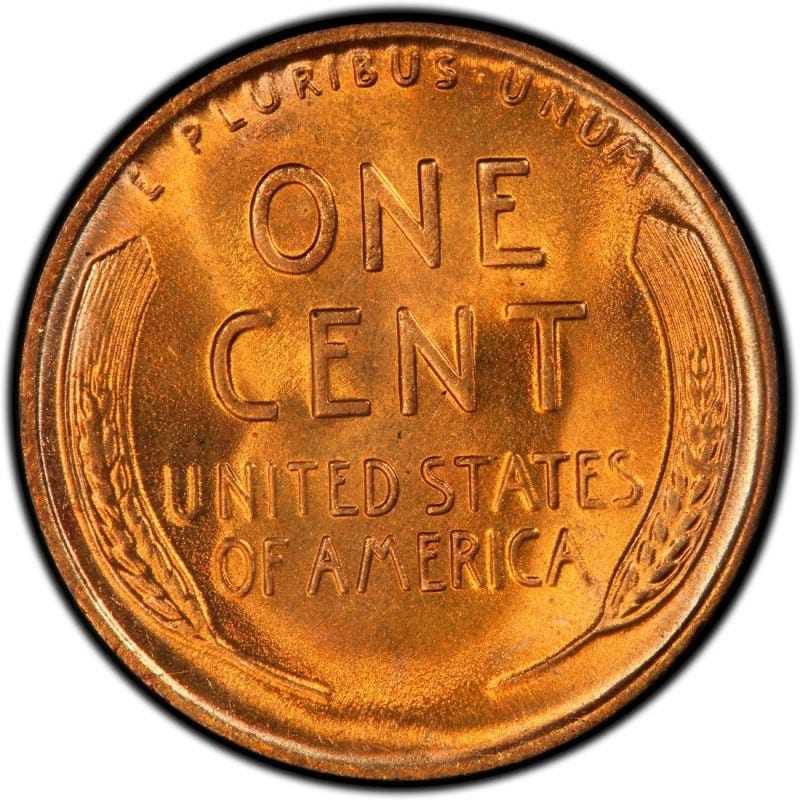
You never knew what you were going to find at a coin show. He’d learned that as a teenager, working a much smaller show on Sundays at the Nutley VFW. Wandering the Coin Expo at the convention center, he didn’t expect to find the twin of the 1931-S wheatback penny that he’d bought with six weeks of summer labor from the walrus-mustached Vietnam veteran who owned Gadzooks Rare Coins, the very cent that Joey’s father hocked for Yankees tickets barely a year later.
Stately, tanned Joe Cucuzza plucked the coin from the table in its lucite case. At forty-nine, his eyes couldn’t discern the fine lines in the grains of wheat like they could at thirteen. He asked the coin seller—a spectacled goof in cargo shorts with hair like Larry from the Three Stooges—for a jeweler’s loupe and inspected the details.
MS-67 was the certified Sheldon rating, and the rich luster of the blood-red copper was what drew his eye all those years ago, and also drew it now. Minted in San Francisco, it had cost sixty dollars in 1983, paid in ten-dollar increments for minding Mr Chundak’s table while he shot Dewar’s and chewed the fat at the bar, or stalked the floor in search of a deal. Mr Chundak always wore a suit. Maybe a dull herringbone or ugly plaid, but always a suit, and that had rubbed off on young Joey; his current summer suit was tailored but discreet, not showy. It hid the eight-inch Italian stiletto in his pocket and the nickel and pearl Baby Beretta in the pancake holster under his silk shirt.
The coin was priced at three hundred and fifty dollars. Inflation. Joey took four bills off his money clip and held them out to the geek, who percolated to life and flustered through giving him change, hand-writing a receipt, and folding it up in a paper bag.
“Superb Gem Uncirculated,” Aldo said at Joey’s left shoulder, reading the coin’s rating. His breath was rank from the sausage and peppers sub he’d bought from the truck in the parking lot. “You are a gem, but you look like you been circulated.”
Aldo was his boss and partner, the red-faced capo of the Quattrocchi crime family, which ran most of northern New Jersey, and got a piece of the action at the Secaucus convention center where the coin show was held.
“I’m MS-55, Choice About Uncirculated,” Joey said. “You, you’re Extremely Fine. A little rough around the edges. It comes from being in so many pockets.”
After a beat, Aldo chuckled. “C’mon, lemme show you something.”
The table announced its presence with a large Nazi flag. It catered entirely to the losing side of wars fought by Americans from 1861 to 1945. Hitler youth daggers, Japanese swords, Kaiser helmets, Confederate currency.
“Look at this shit,” Joey said. “The vets never allowed that at the VFW. Said they saw enough of it overseas.”
Aldo shrugged. “Money is money, Joseph.”
Joey noted that his Italian forebears rarely kept any mementos from the shameful Mussolini era. Even the ones who supported him shut up about it after he was strung up by his balls in the public square. In Germany it was illegal to sell Nazi memorabilia, but in the States, it was romanticized and fetishized by a certain kind of person.
Dry-balls, is what Joey’s old man called them, among other things. Like “half a fag,” which to his homophobic, hyper-masculine father—a quarry truck driver who looked like The Thing from the Fantastic Four comic books, only hairier—said was worse than being a whole queer, because at least they “had the balls to be what they were.”
Joey had realized he was of the whole cloth when he was 12 years old, watching The Beastmaster on their stolen HBO, and found himself more enthused with the oiled and muscled Marc Singer than the equally ripe Tanya Roberts as the duo led their menagerie against Rip Torn’s tyrannical overlord. The bullies discovered it soon after. Joey was slender and fit, but had full lips that they called “dick suckers” as they cornered and beat him.
Joey’s father had at least taught him to fight. He absorbed it by dodging his fast big hands, which were later fed to the crabs in a polluted lagoon in the Meadowlands. A bonding experience between a younger Joey and Aldo.
The Nazi table was run by two men—one big and heavy, the other short and muscled—and their cold little eyes excited Joey at the prospect of a new bonding experience to be had.
Aldo ignored the stack of literature that involved neither coins or militaria, but instead shouted conspiracies and denial of history. He pointed to a Japanese samurai helmet on display next to the swastika flag.
“The Green Manalishi with the Two Prong Crown,” Aldo said, then air-guitared a heavy metal riff. “Judas Priest. We saw them at Garden State Arts Center, remember?”
The original was by Fleetwood Mac, but Joey didn’t correct him. Aldo was more affected by ‘80s nostalgia than he was. He also played football for Queen of Peace and was homecoming king, and even the gay priests were none the wiser. Aldo had learned to fight out of desire, not need.
The helmet was certainly not an antique. It looked more Darth Vader than Shogun, and was airbrushed in metallic green like an insect. Or Aldo’s garish custom IROC Camaro. Joey loved him, but his boss and partner was pure New Jersey guido, down to the gold chains and Fila tracksuits. His current number was a throwback design modeled by Tony Soprano, which Aldo thought was hilariously ironic now that he controlled the turf the fictional mob boss once lived in.
Joey tolerated it. He was the jealous type, and though Aldo had jangled in more pockets and purses than he cared to think about, he kept fit, and a baggy tracksuit meant fewer old goomars grabbing his biceps and throwing themselves at him. A boss had to take a taste now and then, or people talked. And when people talked, they had to be killed.
That didn’t bother Joey, but as the boss’s fixer, the clean-up was his duty. Why make more work?
“Tell me that helmet wouldn’t look awesome in the garage next to The Green Machine.”
Joey relaxed. Better in the garage than the parlor.
“You like that, Antnee?” Little Shitler’s acne-scarred face broke into a smile, and he nudged his buddy, Der Super Schwein. “Two hundred. All custom work.”
Joey squeezed Aldo’s forearm. He knew he was carrying the mate to his abalone-handled stiletto, and was hungering to gut the little scumbag like a bluefish after the “Antnee” crack.
“Just looking.”
Der Super Schwein huffed. “Then go to a museum.”
Joey’s Uncle Paolo had taught him that Italians had only recently been inducted into whiteness and all its privileges. These two specimens likely considered them too swarthy to have full membership.
“We’re not giving these two dry-balls a dime. They shouldn’t even be here selling that shit. It’s a coin show, not a Skokie reenactment.”
Aldo sighed. “We’re doing this?”
Joey turned to the soldiers who followed them ten feet behind. If Aldo wanted that ugly helmet, damn right they were doing it.
“Everybody’s avoiding this table like a fresh turd.” Everyone except Aldo, of course. “They’re scaring away business. I’ll give them a pro-rated refund.”
Aldo’s face hardened. Joey had overstepped. “They’ll make a stink, and scare off more people. Just make ‘em get rid of the flag and the books.”
Once the apes maneuvered to their flank like two dreadnoughts, Joey leaned over the table to the proprietors. “We’re the management. You have to take that flag down and put these books away.”
The little Nazi pinched his face together. “We’re still in America, capisce? We got the First Amendment.”
“Yeah, and we’re not the government. But we are in charge of this facility. If you prefer, we can have your entire table removed.” Joey flashed the cracked-tooth grin that was just sharklike enough to warn off any but the stupidest. He was a mako, not a great white, but no less deadly.
“Whatever you say, Gabba Goebbels.”
There was a lot of sighing and grousing and even a few muttered slurs, but they took down the swastika and put the books under the table.
“Guess you don’t want me celebrating Tojo, either.” Little Shitler took the Manalishi helmet from its display and set it on the floor. “No longer for sale, Antnee.”
Aldo ignored them, as was his wont. He didn’t get angry, not openly. The back of his neck turned a shade toward the ruby red penny in Joey’s pocket. Joey patted him on the shoulder. “Let’s go get some zeppoles. These assholes gave me agita.”
* * *
They enjoyed the autumn air and the cattails of the northern tip of the Meadowlands. The cigar-like pods called punks—which their parents used to light up like citronella candles to keep bugs away—wagged in the breeze.
“You’re all bent out of shape over those inbred fucks.” Aldo stuffed one of the fried dough zeppelins into his mouth and dusted his tracksuit with a snowfall of powdered sugar.
“They’d be first in line to watch us burn.”
“That’s not gonna happen.”
Joey tore a zeppole into pieces and ate them off a napkin so as not to sugarcoat his suit. “It did.”
“That was a long time ago.”
Aldo ate another zeppole whole. He noticed the sugar on his shirt and smeared the dots into streaks with his hand.
“Since when? Gay kids still get the shit beat out of them.”
Aldo and Joey were an open secret. The operation didn’t care because they were both good earners and didn’t flaunt it. Among New Jersey mob bosses, they were among the least flamboyant, without even trying. The job was better camouflage than being Broadway stage directors or dress pattern makers.
“We all gotta take a beating sometime. It’s one table. If they bust your balls so much, I’ll tell Larry Sbarra they’re banned next time.”
“Please.”
He patted Joey on the cheek. “I got to go meet the dock boss. Take the rest of the day. Hit the gym, or whatever. Just don’t bring your work home.” He walked to his Escalade.
Joey wiped his hands clean and took the 1931-S penny out of the bag.
It was almost certainly not the same coin his father had stolen, but no matter. Coins were about memories.
The first old coin Joey remembered finding was a Mercury dime in change from the Italian ice truck. Instead of Roosevelt’s profile, a silver Adonis winked back at him. On the reverse side, an axe. His uncle Paolo told him that the tiny ‘S’ beneath the date meant it was minted in San Francisco, a city he waxed rhapsodic about, having lived in Haight-Ashbury and the Castro before settling in Greenwich Village.
Joey’s uncle showed him how to be a stand-up guy, not a hot-head like his father. Uncle Paolo had married, given his mother a son, and divorced before striking out on his own, driving a Volkswagen Karmann-Ghia roadster home from out west to live the Bohemian life in Manhattan, running gay clubs for the Linn Brothers of the Jewish mob. He told Joey how they got raided by the cops despite the payoffs, and the Stonewall riots that ended the practice.
Uncle Paolo hadn’t participated, but he collected bail money for the trans sisters who kicked it off. He was too much of a good worker to leave the till unless the building was on fire. Even then, he’d sell drinks with one hand and aim the fire extinguisher with the other. He’d been held up with a double-barreled shotgun to his heart, and was back behind the bar the same night, after giving the police report .
He’d survived all that, to get killed for nothing.
* * *
Joey gave the Alfa Romeo Guilia Quadrifoglio heavy pedal as he drifted around the backroad curves of the Meadowlands. The stereo thumped “The Green Manalishi in the Two Prong Crown” on repeat, alternating between the rough Fleetwood Mac version and the slicker Judas Priest cover. The driving beat hypnotized him with Peter Green’s haunting excoriation of a jealous god who would have no other.
To Aldo, the Green Manalishi of the title was a villain from a low-budget ‘80s movie, an unkillable spirit clad in samurai armor. Not much scared Aldo, except something he could not hurt.
Joey saw the Manalishi as something else. He’d read up on it, after that humid summer night at the outdoor concert where the leather-clad metal gods of Judas Priest rocked out for the first encore. For Peter Green, the Manalishi was the living personification of greed.
It was the last song he recorded with Fleetwood Mac as they rose to success. He didn’t like what fame and money had done to him. Their gifts came with the price of abject worship. You couldn’t coast on the highway and enjoy it. Your masters wanted more.
Joey knew the feeling.
His uncle had, too.
Running one club wasn’t enough. They had him juggling three, one in Brooklyn Heights and two in the Village, sending him over the bridge every night. Uncle Paolo was exhausted after closing the bars and Joey had to wait patiently as he snoozed on his nonna’s floral print couch. Once he woke up, they’d watch the Sunday afternoon creature feature on WPIX-11. Godzilla, or The Mushroom People, or if they were lucky, Jason and the Argonauts or Sinbad.
Uncle Paolo wasn’t a big walrus like Mr Chundak of the coin table, who was a Green Beret. But they were bar chums, and Unc got Joey the job to get him out of the house and away from his father’s heavy hands. He’d heard them talking, deep in their cups, when he came to retrieve Mr C for a customer dickering over the price of a Walking Liberty half dollar.
“You should carry a piece, Paulie.”
“I never make the drop, what would they want with me?” He took out a money clip shaped like a dollar sign, studded with stones. “I keep a fugazi hundred in this rhinestone piece of crap. I’ll toss it and run away pissing and farting like Mothra was chasing me, right Joey?” His round face lit up, reddened from his cheeks to his balding crown, combed back without vanity.
That was the last Sunday Joey saw him alive.
In Manhattan in the ‘80s, a mugging that went sour was barely news. Nonna howled and threw herself on the coffin, all in black. Joey’s mother never recovered, like a piece had been cut from her.
In the funeral home parking lot, smoking with his buddies, Joey’s father called it a fag-bashing. “That’s what happens, Joey. That’s why I teach you to fight.” He turned to his pals. “Not that my kid’s some finocchio. But he looks soft, don’t he? You gotta watch out for that shit. Nip it right in the bud.”
The lawyer for his uncle’s killers said the deceased had flirted with his clients and their rage was justified. The jury agreed, and convicted them of provocation manslaughter. Probation and time served.
Once Joey got made, he got their names from a degenerate gambler in the NYPD. Two had died already, another hopped a merchant steamer. Joey parked outside the last guy’s shithole in Yonkers, holding a throwaway piece between his ankles. When he saw the miserable prick stagger home after his shift, he decided letting him live was better punishment. He ice-picked the guy’s tires and paid off a cop to ticket him once a week until the poor bastard got an ulcer, and called it even.
That had been enough, for a while.
But there was always something in the news. The kid they crucified on a fence out in cow-fucker land. The Rutgers student who jumped off a bridge after his roommate recorded him with a date. The lesbians who worked at the port, who came to Joey to get the jerks with seniority off their backs. It was a given you had to buy a job from the hiring agent, but these guys wanted a blow job with the vig. Joey made them behave. For a price, of course.
The Green Manalishi must be served.
His uncle thought juice would protect him, but he was a knock-around guy. Joey was made; killing him had consequences. At the ceremony, one hefty capo wanted to make Joey fuck one of his Russian girl whores to show fealty.
“You think that’s the first I fucked?” Joey had said, and unzipped.
That homophobic fat prick was the one who dubbed Joey “The Cucuzza.”
A lengthy squash prized by southern Italians, grown in every nonna’s backyard garden—usually hanging from a chain-link fence in the sun like pale green Louisville Sluggers—he’d earned the name from both his daring and his endowment.
“When I got made, mine was shrunk up into my balls!” the current boss had said, and everybody laughed. After that, Joey was golden. He burned the card of Saint Sebastian, swore omerta, and never openly showed the fat capo disrespect.
He got pubes in his eggplant parmigiana every time he ate a restaurant in Joey’s territory, but he got to live. He was a made guy.
The two Nazi fucks had no such protection.
* * *
Joey wasn’t a killer. He’d killed, but he wasn’t a killer-killer. They had apes for that. His Baby Beretta was mostly for insurance, as Aldo’s slice of New Jersey, which included the ports, was worth killing for. And made or not, there were ways. Some kid whacked a boss out in Staten Island, and blamed it on an internet conspiracy. Joey was pretty sure it was internal, set up a captain who wanted a bigger piece.
Joey wasn’t sure what set him off more. The brazen Nazis, or Aldo’s reaction to them. They’d had shouting matches at Aldo’s house in Essex Fells over it before. Aldo was like Uncle Paolo.
Who he loved was nobody’s business.
It reminded Joey of the first time he heard the word “gay” as a slur in school.
He was waiting in line behind a girl for Radcliffe school to open. There were separate doors for boys and girls, with the label carved in stone above them, but they didn’t separate the sexes like they had at Catholic school. His father said they couldn’t pay for it anymore, so Joey changed to public school in third grade. He didn’t have to wear a uniform anymore, but he didn’t have regular clothes, so he showed up in a white shirt and chinos, the perfect target.
“What are you, gay?”
It was an older kid with a dusting of mustache, and two younger toadies.
“I’m happy, but I’m not gay.” Joey would read the dictionary when he couldn’t find a new book.
“That’s halfway there, queer bait.”
He asked his mother what the words meant when he walked home after classes. Her face seemed to melt.
Joey’s heart raced like the Alfa Romeo’s engine. He had asked a porter at the convention center to show him the Nazis’ truck. They had an old white Econoline van. No swastikas, but a mosaic of bumper stickers covered the back.
Don’t Tread On Me. Confederate Stars and Bars. How’s “Coexist” Working Out For Ya?
He memorized the plates and called it in to a bought Port Authority cop. They lived in Butler. Half an hour up Route 23.
The house looked just like its neighbors.
It wasn’t far from where Uncle Paolo had told him there had been an German-American Bund camp back in the ‘30s, where American fans of Hitler dressed in brown shirts and marched for their fuhrer.
“The feds shut them down after Pearl Harbor, but what do you think, they disappeared? They all decided to love their neighbors?” Unc rolled his eyes so hard Joey felt it. “No. They raised little Nazi kids. Our neighbors. Never forget that. Half the people are good, one half are bad. And the other half will look the other way while the bad half kills you.”
For someone who ran three sets of books on multiple establishments, his math was off, but Joey never forgot it.
What was he gonna do, burn down their shit shack?
Not after driving his shiny blue Italian sedan down their street. But it felt good to think about.
Anger issues. He’d worked hard to get a handle on them. He didn’t want to turn lobster red like Aldo every time someone yanked his chain. It was unbecoming in a leader, and now that they were on top, they had to fight to stay there. Being known as a hot-head, like Joey’s father, was just one way to put a target on your back when someone young and ambitious wanted your territory.
* * *
He drove to his uncle’s grave, next to his grandparents’ in a sprawling cemetery with a gorgeous view of Manhattan. Joey Ramone was buried on the Jewish side, his marker covered in pebbles from fans. The florist was closed, so he stopped at a hot dog truck and bought two with a Chocolate Cow drink. One with kraut, relish, and mustard for him, and one with hot onions, like his uncle used to get.
He set a towel down in the freshly cut grass and watched the sun burn across the glass towers of the City like God’s judgment.
There was one more space in the plot. His mother would be buried with his father, and Joey had claimed this one. He had his name carved below Uncle Paolo’s with his birth date and the dash hanging there like a knife at his throat.
Guys like him and Aldo usually got a free plot in the Meadowlands, but at least his name would be here until someone with enough juice had it leveled for condos.
Uncle Paolo would say to let the Nazis be.
After his uncle’s bar was robbed, the Linn Brothers found the gunman and asked if he wanted to watch them cut his hand off. He knew better than to dissuade them, but he demurred from attending the punishment.
Young Joey had been excited about it. “I’d want to do the chopping!”
His uncle mussed his hair, which Joey disliked even then. “You say that now, but if you did it, you’d regret it. He scared me, that’s all. He didn’t pistol whip me, or even raise his voice. As far as thieves go, he was a gentleman.”
“Then why are you gonna let them do it?”
“No one ‘lets’ the Linn Brothers do anything. Men like that, you stay out of their way. The thief knew what he was getting into. That doesn’t mean I need to be part of it.”
Joey learned, long after the Linns were found dead in the trunks of their respective Cadillacs, that his uncle had sent money to the thief’s family. He hadn’t made it to the hospital after his amateur amputation. He wasn’t mobbed up; his crew might help his widow and kids, but like chipping into the bail fund at Stonewall, his uncle did what he thought was right, behind the scenes. It was safer, but it still mattered.
At least Joey liked to think so.
He left the hot dog with the onions in the grass, and poured a little Chocolate Cow out for his fallen uncle.
* * *
He filed away the Nazis’ address. Someday, when he couldn’t hurt some mouthy untouchable fuck in the organization, he’d send the apes to their place. And he’d feel good about it.
Anger management comes in different forms.
Projection, the book he’d read called this.
One thing he’d learned, partnered with Aldo, is you did whatever worked. They were opposites in a lot of ways, but they made it work. Sometimes that involved projection. And sometimes you went to bed angry, like he would tonight.
He hit the gym late, got a good pump, then cycled through the sauna and the cold shower until he didn’t feel like emptying the Baby Beretta into two Nazi faces every time he closed his eyes.
Aldo’s truck wasn’t in the carport, so he parked in the garage next to the Green Machine IROC Camaro. Aldo kept it in a plastic climate-controlled cocoon like a time capsule from 1989, when he’d graduated high school. It only came out on days with zero percent chance of rain. Aldo even had a decrepit old cooler in the backseat full of mix tapes he’d made in the ‘80s on his boombox, and played them loud when he took it out for rides.
Glory days.
Joey went inside and set the 1931-S penny on their trophy shelf, in front of a photo of him and Aldo in Capri. It gleamed like a ruby eye.
He made a pitcher of negronis—Stanley Tucci style—and sipped on one while he waited, with “The Green Manalishi” on the stereo to wash the murder scenes out of his head. Sometimes an old song worked like a zen koan to cleanse the soul.
The green beasts, greed and jealousy.
He was jealous that Aldo put money ahead of his wishes, but Aldo was right. This was business. Just like Uncle Paolo sold drinks at The International Bar, while six blocks away, history was being made outside the Stonewall.
People gotta drink during history, too!
The ruby eye of the penny glared down on him. Killing his uncle’s killers wouldn’t bring him back. But maybe it would have saved someone else. Or kept them from raising more little killers. How many little Hitlers had those two inducted?
Thoughts like that kept Joey up at night.
And Aldo, who knew why he couldn’t sleep.
Tonight would be one of those nights.
He took a clean phone out of a cubby and punched in the number of his favorite ape. His thumb hovered over the send button. That old Econoline van could go up in flames. He’d get pictures, and they would help block out the misshapen face of his uncle in the briefly opened coffin, that young Joey only saw because he’d sneaked out of the car while his father had a smoke.
His thumb polished the button like a bead on his nonna’s rosary.
Her wails echoed through his head.
He raised his thumb.
And the door clicked open. Aldo strutted in wearing a nice linen shirt and slacks, a shopping bag in his hand.
Joey quickly closed the burner phone and stuffed it between the couch cushions. “You’re late.”
“I had business,” Aldo set the bag on the coffee table. “You remembered! Thanks, babe.” He tried to mimic Rob Halford of Judas Priest as he howled through every octave. The man had range. Aldo did not.
He patted Joey on the shoulder. “Maybe this is our song.”
“We can discuss it.” Joey kept a straight face. Aldo had changed out of the ridiculous tracksuit, and he had to acknowledge that.
“Whaddayoo mean? This was one of our first dates.”
“That was not a date. I only went to see the opening band.”
“Whitesnake? Here we go again… you sure you want to confess to that? Rob Halford is openly gay. I thought that meant something to you.”
It was true. Halford’s coming out had been a big deal. And it hadn’t lost them any fans worth counting. He had dressed like a leather daddy since the early days, and drove onstage on a chromed chopper, before singing stuff like “Grinder, looking for meat” and “Hell Bent for Leather.” It didn’t take a genius to figure out. Most of the stoner metalheads had probably mumbled “oh yeah,” and kept banging their heads to the anthems of a band that defined their youth.
“All right, it was a date.”
“What about tonight? Is tonight a date? You got all gussied up at the gym, I see.”
Joey wore a snug viscose tee-shirt and loose shorts to show off his leg day workout. Aldo usually didn’t notice. Or maybe he did?
“It can be.”
“Pour me one of what you got.”
Joey went to the open kitchen and made two fresh drinks. He could dig out the phone and call the hitter after Aldo conked out. Then he could sleep.
He returned with two martini glasses.
And nearly dropped one.
Aldo held up the green samurai helmet, positioning it on the shelf above the photo of them in Capri. “I just couldn’t leave this behind. I know it clashes with the feng shui and all that shit.”
Joey steadied the glasses. The two prongs of the helmet gouged the ceiling. The mask was like a skull, two sockets stared down as empty as he knew their souls to be.
“No, green is a good color. It brings money.”
Aldo positioned the helmet, and turned with a boyish grin. “That’s good. Because it’s all about the money, right?”
“Right.” Joey handed him a glass.
“Those two mooks made us enough. They won’t be back Sunday.” Aldo’s face was still a little red at the edges from exerting himself.
Joey would wait until later to ask about their fate. They would both sleep well tonight.
“A drink isn’t a date.”
Aldo touched glasses. “I got Angelo’s in the bag. Lobster oreganato, hot shrimp with the biscuit, calamari… after that workout, I was morte di fame.”
Joey smiled. “Thank you.”
“Anything for my jealous Manaleesh!”
They drank.
“So, how about we watch Road House while we eat?” Aldo sank into the couch like a yacht’s anchor. “It’s a Swayze night.”
“Come on, Dirty Dancing. It’s got a perfect plot.” And Aldo liked Jennifer Grey.
Aldo fished the containers out of the bag and opened them. The room was flooded with the scents of butter and garlic.
“I’m afraid that tonight, I’m gonna put baby in the corner. I need to watch shit blow up.”
Joey sat back and sipped his negroni. “Double feature?”
Whatever the decision, he knew they would make it work.
—


Such a tender story about love & grief & also a couple of Nazis getting killed. Love it.
I love this one...an oldie but goodie. 🥰