The Beast in Me
from Better Than IRL: Finding Your People on the Untamed Internet, edited by Katie West and Jasmine Elliott
This and “The Little Gold Colt” are the only two personal essays I’ve had published. They take a lot out of me, and I have great respect for nonfiction writers such as Roxane Gay, Barry Lopez, Annie Dillard, and Lauren Hough who write stunning essays and books from life. I’d much rather live in my own fantasy world when writing. But this one meant a lot to me. I didn’t “grow up” online, but I’ve been in front of a screen since I was ten or so, from programming my Atari 800, to Bulletin Board Systems on an early PC, to Usenet and UNIX. Forums, chatrooms, and MUDs, Multi-User Dungeons, an early form of Massive Multiplayer Roleplaying Games, were where I found who I really am, and the multifaceted aspects of my identity. I largely share these in my writing, and that was honed by exploring my other personae online… as this essay reveals. You can buy a copy of Better Than IRL: Finding Your People on the Untamed Internet here.
The Beast in Me
by Thomas Pluck
The first time I logged onto a chatroom, I killed the first person I met.
To be fair, this chatroom was a MUD, a “multi-user dungeon” based on fantasy text adventures, so I was forgiven for mistaking it for a game. Later my victim and I would be lovers, and then friends. An odd reversal, but “cybering” — or “tinysex”as chatroom shenanigans were called — was less intimate than divulging personal details, like your name.
The original MUDs were the first MMPORGs, multiplayer text fantasy games inspired by Colossal Cave, the first computer text adventure. Sold as Zork by Infocom, it spawned a hundred imitators, and fans of interactive fiction still create and share new games. Some MUDs were timed, and your avatar was supposed to collect treasures, fight monsters, and solve puzzles before the game reset in a number of hours. You could play nice and help other characters or hinder them and compete. Or you could hang around and talk, by typing say and words in quotes, such as:
Roxiana says, “Stop looking at my tits, Japhet.”
or /em (short for emote) for actions, like:
Japhet grins. And thinks about them, instead.
The social thing caught on, coders made spinoffs called TinyMucks (a pun on playing in the mud), and all sorts of variants blossomed on secret ports on college servers. On these, you could hold long conversations in virtual “rooms” full of other characters or go off alone as a couple and have cybersex, typing at each other one-handed.
There was a whole host of people I knew intimately back then, everything except for their real names. People like Peganthyrus. Ashtoreth. Misty. I was Japhet, a charming thug brazenly based on James Gandolfini’s psychopathic mobster Tony Soprano, and Roxiana, a rapier-wielding fox musketeer who fended off the advances of the over-amorous furries with wit and violence. Life on the MUDs was a book you wrote as you typed, a book you could live in! It was addictive and terrifying.
We lived in those digital worlds practicing different versions of ourselves, learning how to be. We might never know each other if we passed on the street, but in those virtual worlds we shared deeply and personally, things we could never tell family or friends. Family wouldn’t understand why you wanted to stay up all night pretending to be a dragon, talking about what new music you downloaded off Napster, your shitty job, or how you were going to pull together a passing grade this semester after skipping your morning classes because you were up all night cybering with Vampire_Lestat, who couldn’t get enough of your kitsune werefox wiles.
As long he didn’t know you were a guy.
To be fair, I had no way of knowing if “he” was a guy. The classic New Yorker cartoon stated, “On the internet, nobody knows you’re a dog.” That goes both ways. In the virtual text world of a TinyMUD, if you don’t break the spell, nobody knows you’re not a six-foot-tall swashbuckling pirate vixen.
Some players kept a single persona, but others had a whole brace of them. I had several across several MUDs, from one based on Vampire: The Masquerade to the infamous den of the furries, FurryMuck. At one point I ran a private one called GooGooMuck on a server for friends to chat on and share music. We all knew each other’s real names by then. Some of us had met IRL and broken the spell, but we still played avatars for the fun of it.
I had cut my teeth roleplaying in high school in a Dungeons & Dragons game, but the furthest I got from myself was playing a Drow elf. Casting spells at umber hulks was fun, but playing a swaggering stud with effortless charm? That was addictive.
Not gonna lie, some of us could write hot. No “Worst Sex Scenes of the Year” awards here, with awful mixed metaphors about vaginas gripping you like a pepper grinder. (Google it.) We had plenty of experience reading slash and other erotic fanfiction on Usenet, and most internet citizens were college students back then, so often it was the first time we were away from home, not having to worry about parents barging in to find us writhing in masturbatory ecstasy.
When the movie Catfish came out, inventing the term “catfishing,” I had to feign surprise when my co-workers professed disgust that someone would pretend to be a different gender on the internet. Because I’d done it for years.
I never used it to con someone like the subject of Catfish. On Mucks it was considered rude to ask. Once you knew someone well, you might “talk RL” and break character in private chats. But if it was a tinysex fling with a vampire who wanted to play with a foxy swashbuckling domina, and the person behind the mask just had to know her player’s gender…well, I cut them off. They broke the spell.
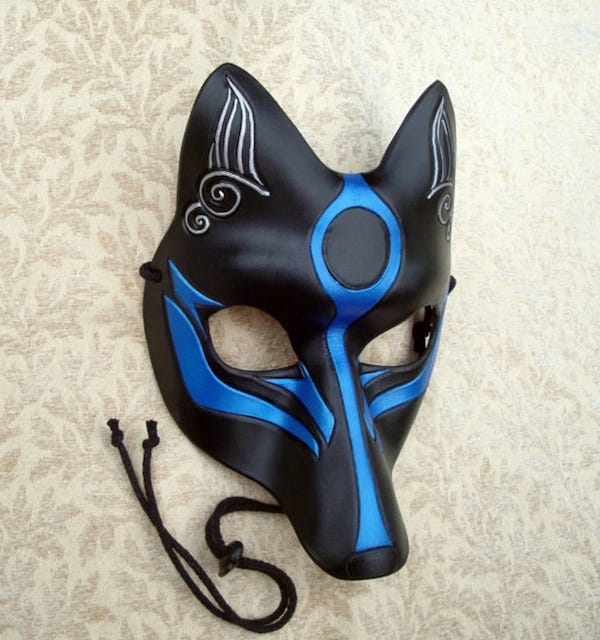
I enjoyed playing Roxiana. I did so for almost ten years, and sometimes I slip and talk about her like she’s a separate person and not an aspect of my personality, like a drag persona (which she was). She was invented when I found a cheap plastic fox mask in a party store that covered my huge acne-pocked face and walked home from school wearing it, talking to my friend Christian in a lilt. I never did that in public again, but it felt somehow right. Freeing.
I knew what drag was from an early age because my uncle ran a gay bar in Manhattan, and the customers and crew were his second family. He knew Divine. I was taught early what trans meant, because Tom the bartender became Betty, and she was as much family as Sasha the leg-breaking bouncer, who protected the bar from gay-bashing scum. I would never conflate playing a different gender online with being trans or even “understanding” trans people better than any another cis male — but virtual gender-switching is a way to briefly liberate yourself from rigid patriarchal roles.
I am a cis bi male writer, but having grown up IRL with flamboyant gay men, trans women, butch lesbians, and toxically hypermasculine het men, I wanted to be all of them. Becoming Roxiana was a form of respectful play, a tribute to women I knew, like my acerbic great-aunt Mary, and Val, the tough Harley-riding lesbian who opened jars of olives for me at cocktail parties. I missed my uncle’s bar family and their stories. Roxiana was born as much from Jerry, the six-foot queen with a flaming red walrus mustache, as the unapologetically strong women in my family. And she was a lot of fun to be.
That being said, at least three of my online friends from the FurryMuck days transitioned, that I know of. I don’t know if playing different personae online was helpful to them, but I imagine it could be. If you changed the sex or gender of your avatar, few questioned it. You could be whoever you wished to be. If one didn’t feel right, you could try another. You could even put multiple avatars in the same crowd and talk to yourself, long before this was called sock-puppetry. If you were insecure, you could have one avatar ask an online friend what they really thought of that other person — wasn’t he a dork?
I had one friend who had a dozen avatars on the same TinyMuck, and I’m certain I didn’t know them all. He was good at juggling personae, playing them against you. I settled on two, almost diametric opposites, and I kept them far apart. They were masks for me, and sometimes a mask is the truest representation of who you are.
But they are still armor, and even in a place where you can “be yourself” you could still need protection. Because not everyone’s self is quite so cuddly. The Mucks were no online utopia. There were individuals just as toxic as trolls and edgelords are today, emboldened by their anonymity.
Roxiana got hit on a lot. I learned a lot about male entitlement, being her every night for years. There was a tool on the MUD that listed every avatar currently online, with their name, sex, and a short description. The “sex” field was only four characters, but you could extend into the description field, so you weren’t limited by the M or F the original coders intended. Roxiana’s was “Yes, but not with you.”
That infuriated a lot of men.
Complete strangers would “page” me (a private message like a DM, for communicating when you weren’t in the same virtual “room”), demanding that I explain why I had written them off out of hand, before even meeting them. “Bitch” was bandied about a lot. Some resorted to begging. Thank goodness the only dick pic they could send was a c= =3 if they were clever, and most of them weren’t. Also, they had to behave.
Because Mucks had something lacking in most corners of today’s internet: moderators.
They weren’t poorly paid, untrained people with no skin in the game; they were players themselves, who cared about the place and keeping it safe. A good troop of moderators kept the trolls at bay. And we were all so addicted to being someone else that the punishment of a ban was terrifying.
As the ultimate punishment, your avatar would be kicked off and re-passworded, and you could never use that name again. But true bans were rare. Someone who made rape threats was banned (imagine that, @jack). But most times you were suspended for a few hours or days to cool off, and it felt like forever. You could make a new avatar, but it wasn’t the same. If you tried to be cute, and log in as let’s say Rox1ana, the community was small enough that mods (called wizards, for their extra “powers”) could spot you from the ban list and kick you off with a warning.
This was usually enough to keep the peace, but there were repeat offenders and yes, edgelords, who got their pleasure from taunting others and bending the rules. In the small hours, when most of the mods were asleep — except for one or two who lived on different continents — the trolls would rule.
One of the most infamous was named Random. He was loathed. He had a knack for bullying, knowing what would set someone off. I’m sure he’s immortalized in a wiki somewhere as a monster, and I can’t say he never said anything bad enough to deserve that. I’m sure he did. He was a sad person who made himself feel better by hurting others. What we call an asshole, in VR or RL.
But we rescued him.
I don’t say that mockingly. A mutual friend just would not give up on him. He would taunt her and she wouldn’t take the bait, while I would lose my temper. She’d throw back insults at Random even harder. Eventually they became like a fictional couple who trade vitriolic barbs, and when I got tired of the Muck’s technical difficulties and hosted my own chatroom, Random was invited.
And he behaved, at least when he was with us. He could’ve been on other Mucks being nasty to people, but maybe he grew out of it.
Over time, like petting a feral animal, we became friends. He was a hefty guy who loved his cat, lived at home, and used other people as an outlet for his frustrations. He never stopped teasing me for playing Roxiana and TinySexing with guys, but I think he was jealous that Rox always rebuffed his advances and taunts. I was truly sad when his mother posted on Facebook that he died. I made a reflexive social media gesture and told her I was sorry for her loss, but not how I knew her son. She didn’t need to know that I only interacted with him online, just that I cared about him and missed him. I’m sure she was aware that he typed away long into the night for much of his too-short life.
Random was awful, but the worst thing I ever heard was from someone who claimed to be a friend, who refused to talk much about IRL. Once he was down and we tried to get him to talk, he said:
You’re all just words on a screen to me.
It felt positively psychopathic. The majority of my friends were people I interacted with entirely online. I couldn’t grok that at all, differentiating between online friends and those you met in person. Eventually I would blur that line and meet many of my online friends IRL. Some for hookups, others for friendship. I’m still friends with a handful today, though we never talk about the times when we played lemurs and vampire hunters by furiously typing in the dark, in dorm rooms or computer labs.
The mirror-black screens we stare at for much of our lives reflect our faces like Alice’s Looking Glass, and the world on the other side can be a safe haven for our secret selves. You can be anyone or anything, if what you type suspends the disbelief of those who read it. In an online chatroom, it requires consent and complicity — I’ll believe in you, if you’ll believe in me — to cast a mutual spell where you can learn to be yourself by pretending to be someone or something else. A spell that’s only broken when someone is boorish enough to talk OOC — out of character — and bring you back to the dreaded real world.
We cast this spell together with monochrome text in a TinyMUD chatroom window, waiting for squealing modems to negotiate first thing in the morning before work or class, to all hours of the night in college computer labs or darkened bedrooms. Pretending to be cyberpunk heroines, sexy anthropomorphic foxes, bubble-eyed anime characters, centaurs, brooding vampires, Disney cartoon characters, or creations of our own making. Roleplaying dramatic or silly plotlines, “tiny-sexing,” and simply chatting in newly fashioned skins of our own design, where we felt more comfortable than IRL. You say it’s not really you, but of course it is; perhaps it’s truer to you than you’ve ever been in the presence of another. To paraphrase Oscar Wilde: Give someone a mask, and they will reveal their true self.
It’s not something I can talk about. Write about, yes. Maybe we could text about it? No, we’d recognize the phone number, or our name would show. We’d have to create anonymous email accounts and type in short bursts, in the middle of the night. Watching the cursor blink, as we eagerly awaited each other’s replies. Thousands of miles away from one another, communicating at the speed of light.
Then I might feel safe enough to share my most secret self, one more time.
--


Love this more and more, each time I read it. Being on the other side of the door of that darkened bedroom, hearing you type away, all hours of the night, I was always a bit jealous of the connection you had to that secret world. I love that you are willing to share this. By the time I got on line, the mystery and secrecy was gone. You had the opportunity to be whoever or whatever you wanted to be. And I honestly think you are so much better for it.
I’ve read this essay before, and I love it more with each reading. I used to follow a sex worker from Australia & her writings -- she has a stunning essay about a previous client of hers, Michael, who also was a little feral, like Random -- Michael’s mother paid for him to see a sex worker. But she kind of tamed him a bit as well, and then she had trouble with her marriage and dropped out of the business for a while and when she came back, Michael had committed suicide. It really affects her to this day, you can tell. I guess my point is -- what I love about this essay is how it centers our desires as an essential part of who we are, and reminds us of how those early days of the internet served as such a wonderful midwife to the blossoming of those desires.