
Penn Museum
Where I Make a Mess of Potamia

If I can’t be near water, being near people who are happy is also known to make me happy. Lately I’ve visited friends in New York, where we walked the High Line, visited a beer garden, and had good coffee and croissants. (Ever since visiting Olive et Gourmand in Montreal, I enjoy a good coffee and croissant. In New Orleans, Ayu Bakehouse fit the bill; the muffuletta breadstick was outstanding as well. In Manhattan, a Maman chain near the Whitney museum sufficed.)
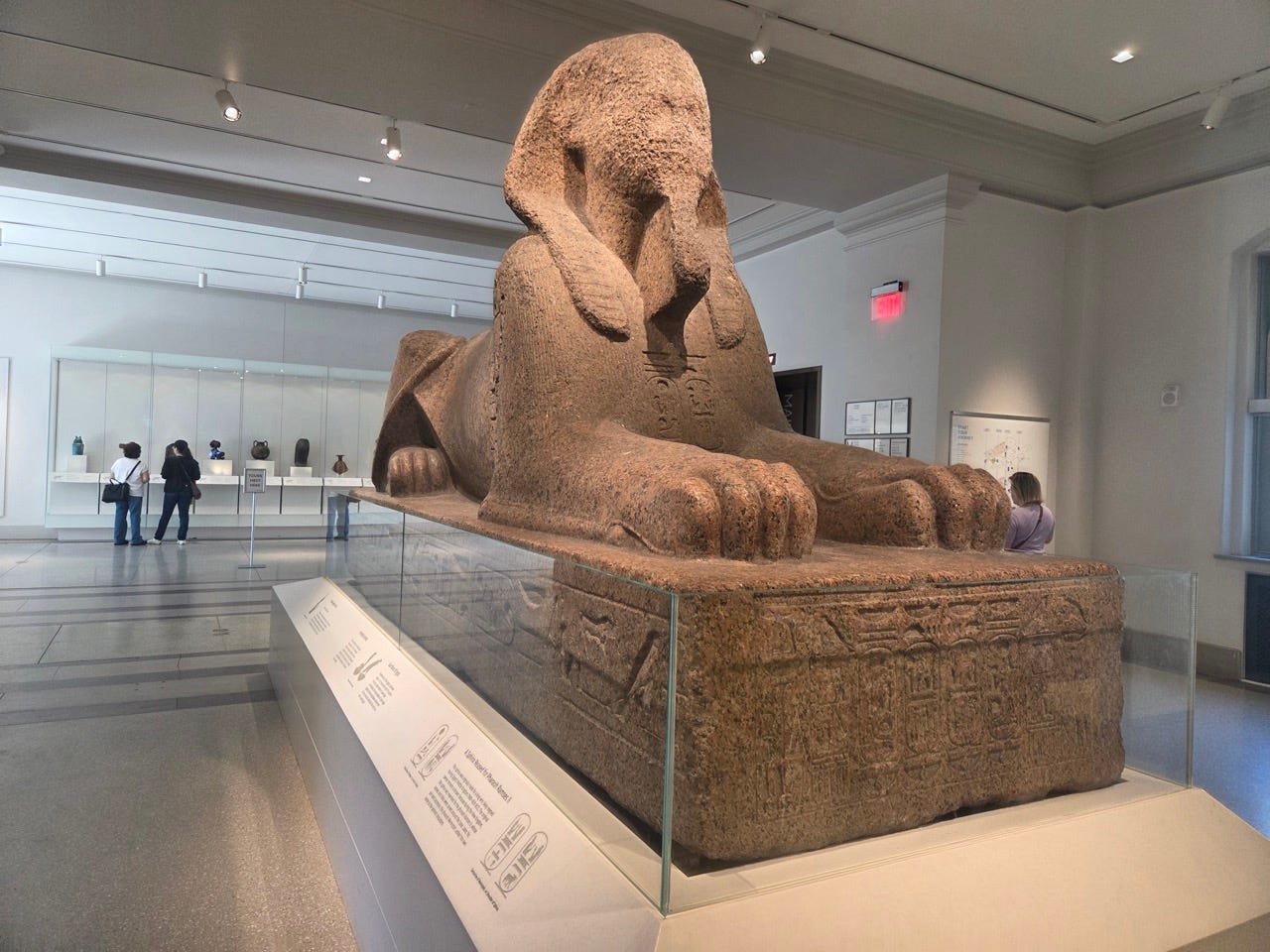
Philadelphia is the city closest to the Pinelands, and despite the wild drivers, robot murderers, and unhinged sports fans, it can be a joy to visit. I made a trip to the Penn Museum, visited a Palestinian restaurant, and a few bookstores on my last trip. It may have been that it was the first mild sunny day in a while, and that I was on the University of Pennsylvania campus, but people were happy and friendly. The Museum is not free, but it was worth perusing. They have the largest sphinx in the Western hemisphere, a wonderful Mesopotamian collection, as well as a fine collection that honors the Lenape people, whose land it sits on.
I am a bit of a Uruk fan, even if I would not want to live there. Even King Gilgamesh didn’t seem all that happy. The wild man Enkidu, tamed by the sexual prowess of priestess Shamhat after seven days of lovemaking, was my kind of guy. He challenged the gods and died doing what he loved (challenging the gods.) The Sumerians didn’t just have temples of devoted to free sex, but holy songs about beer. Though beer seems to have been a palliative for servitude, there’s something alluring to me about the first city and its epic song about its supposed first king.
I’ve written before about the Epic of Gilgamesh, and my reading of the Stephen Mitchell translation:

There’s a new verse translation out by poet Simon Armitage, which I look forward to reading. But you don’t learn much about the people in the epic. That’s where visiting a museum with a collection of artifacts can be useful.


The gold beer drinking tube was likely for special rituals or rulers, but that didn’t stop me from trying to slake my thirst.
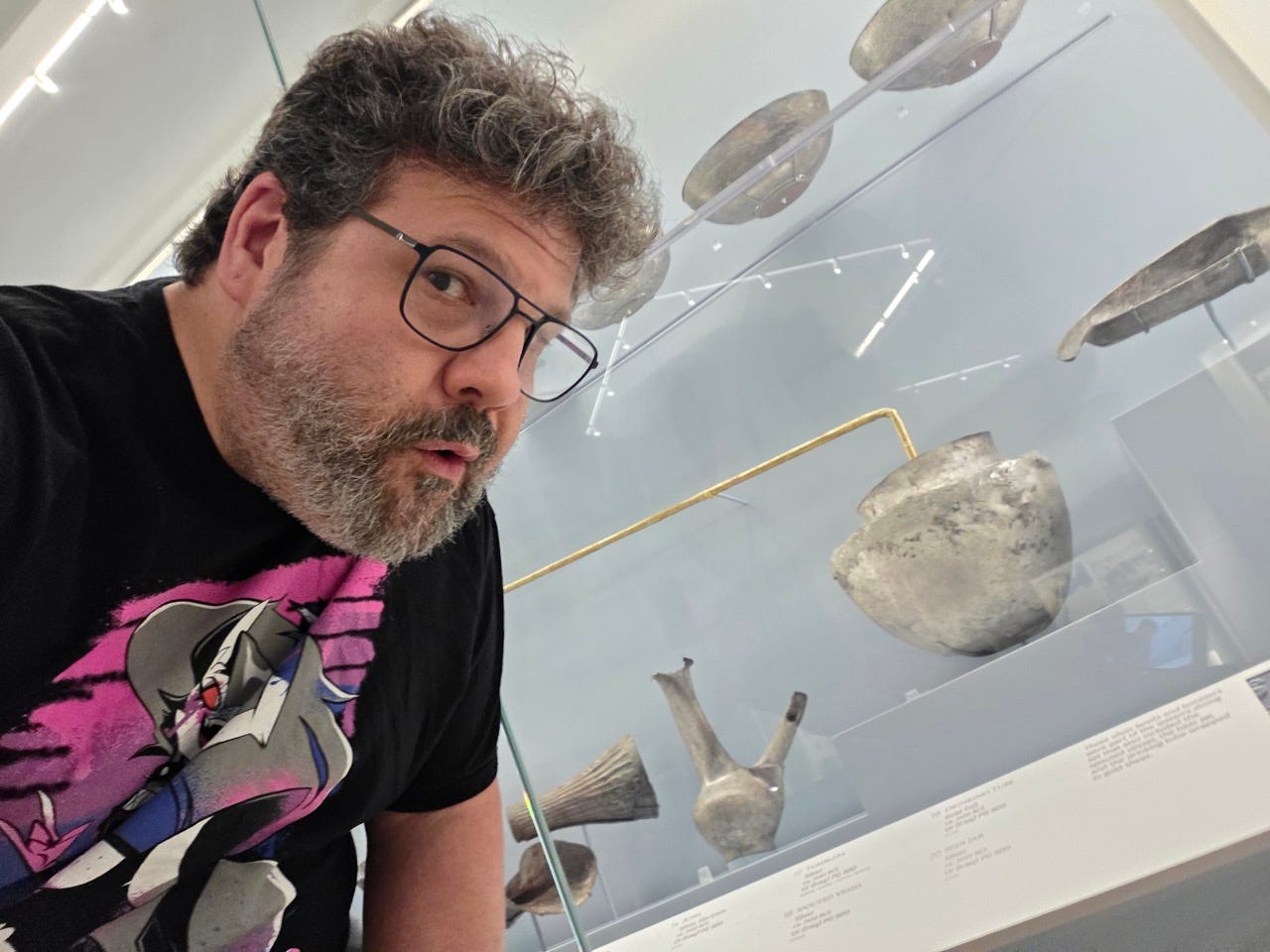
Five thousand or more years ago, “beer” was a cloudy beverage made from leavened bread and sprouted barley left to ferment naturally with date syrup until the yeast chowed on the sugars to form alcohol. More like chicha, drinks made from fermented fruit. Brewers have made modern versions, but I have not found them. Because I would try them! I’m not interesting in making my own beer.
Modern civilization is a great improvement. I’m currently reading Debt: The First 5,000 Years by David Graeber, which along with Against the Grain: A Deep History of the Earliest States argues that humanity’s reliance on the easily stored (and stolen, taxed, or levied, thus setting the stage for serfdom) foodstuff domesticated us and paved the way for militarism, as it can easily feed troops on the march, and be raided. It’s enough to make you go gluten-free! Except rice fits the bill, too. I’m not giving up bread and beer anytime soon, but it is interesting to theorize why humanity seemed to go in this direction. Debt focuses more on how this led to debt peonage and slavery. Cheery stuff, I know.
This is why I read Fix The News. It is important to realize that things are improving, despite the efforts of some. Even though the climate news can be depressing, “Wind and solar just generated more electricity on Earth than fossil gas. In April 2026, wind and sunshine supplied 22% of the world’s electricity compared with fossil gas at 20%.” From this update:

I don’t have a crystal ball to see the future. But the Penn Museum has one, of unknown provenance:


It’s at least a hundred years old, but that’s all we know. I tried not to look into it for too long, while beneath the dome in their Chinese art section.
Another set of items that intrigued me were the vandalized statues of Hermaphrodite, in the garden of Diana, and the Pueblo Revolt of 1680.


When not outside, I enjoyed books and movies, like Monk and Robot by Becky Chambers, which contains two hopeful science fiction books, each about a hundred and fifty pages, called A Psalm for the Wild-Built, and A Prayer for the Crown-Shy. The stories are about Dex, a young person who tires of the city and wants to hear crickets, which only survive in the wild half of the world where humans have left nature to its own devices. To hit the road, they become a tea monk, who listens to people’s problems and serves them tasty teas. They travel in a bike-powered wagon that turns waste into energy, and they meet the first robot to contact humans since they became sentient and were emancipated from factories, generations ago. Mosscap wants to learn about humans, and who better to follow than a tea monk? It’s wonderful without being too twee. I loathe the “punk” suffix being applied to any genre of speculative fiction created after 1984, but this is called “hopepunk.” It feels like a genre of its own, because the books that people recommend to follow these don’t sound the same at all.
For less hopeful but much funnier, I recommend This Book Will Save Your Life, by A.M. Homes, which was very funny, despite predicting the Malibu wildfires but at least a decade. I need to read more of Homes’s books, but I’ll likely skip the one about the murderer. It’s about a retired rich white guy, which usually means no for me, but John Waters blurbed this one, and it made me laugh out loud many times.
I went to see I Love Boosters and Mortal Kombat 2 in theaters, which were both good fun in different ways. I loved Boots Riley’s first movie, Sorry to Bother You, down to its surrealistic and bizarre ending where a tech billionaire is turning people into horse-hybrids to make them better factory workers. (The soundtrack also “slaps,” as the younglings say.) I’d read the screenplay when it was published in McSweeney’s, and loved it then, too. Boosters is similar but different, and while fun, didn’t seem… wild enough. Reality has caught up. I did like the thieves’ solidarity with the Chinese workers who make the couture they crave. The movie and soundtrack approach the wildness of early cartoons.
Riddle of Fire was another indie flick I really enjoyed. A trio of feral dirt bike children need to bake a blueberry pie for their mom to get the TV password, and fall into an adventure involving a mountain witch and her thralls… it has a ‘70s vibe but never falls into nostalgia. It’s set in the modern day and keeps is fun tone throughout.
My “big books” for summer look to be Master and Margarita and Don Quixote, and Red Seas Over Red Skies and The Actual Star for big fun reads. We’ll see if I keep true to this plan…
Next week, back to birds! I visited Wenonah Woods for the Big Day, and saw a Pileated Woodpecker on Mount Royal, in Montreal.
The received wisdom is that beer was first "discovered" when grain stored for baking accidentally got wet.
Apparently, there's a contrary hypothesis that making beer was the initial impetus for cereal cultivation, and it's actually *bread* that was the by-product.
Both seem plausible, although I learned about the "booze first" theory from a buddy who worked in a brewpub, so he might be biased😃.
Enjoy DON QUIXOTE!
"For less hopeful but much funnier, I recommend This Book Will Save Your Life, by A.M. Homes, which was very funny, despite predicting the Malibu wildfires but at least a decade."
I loved this book. And I agree about the main character. If it wasn't Homes, I'd have never gotten past page one.