Good People
chosen as a distinguished mystery story in Best American Mysteries and Suspense 2021
Good People
by Thomas Pluck
I. The Trail Guy
His name was Everett, but the few who saw him called him The Trail Guy. Sighting him on the rocky, meandering trails behind William Paterson University was not uncommon, akin to crossing the path of a doe quietly browsing with her fawns, encountering one of the forest’s shy denizens, and often just as wondrous. He had a light foot, and you barely heard him even when leaves covered the trails, and he sported a thick, tawny beard and wore faded fatigues over a dull gray tracksuit that made him blend in with the second-growth maple and pine plantation as easily as the deer who called the woods home.
The students who enjoyed nature considered the trails of High Mountain their secret tract, and spotting the Trail Guy was a rite of passage. Speaking with him was a rare accomplishment, for if you spotted him, it was likely because he was in motion—headed away from you if he could—and if he couldn’t, he wouldn’t meet your eyes and would often respond to everything from a greeting to a question with a nod and a grunt as he bushwhacked past, slipping through a thorn bush to crest a ridge, or slipping between lichen-spotted glacial erratic boulders to disappear into the brush.
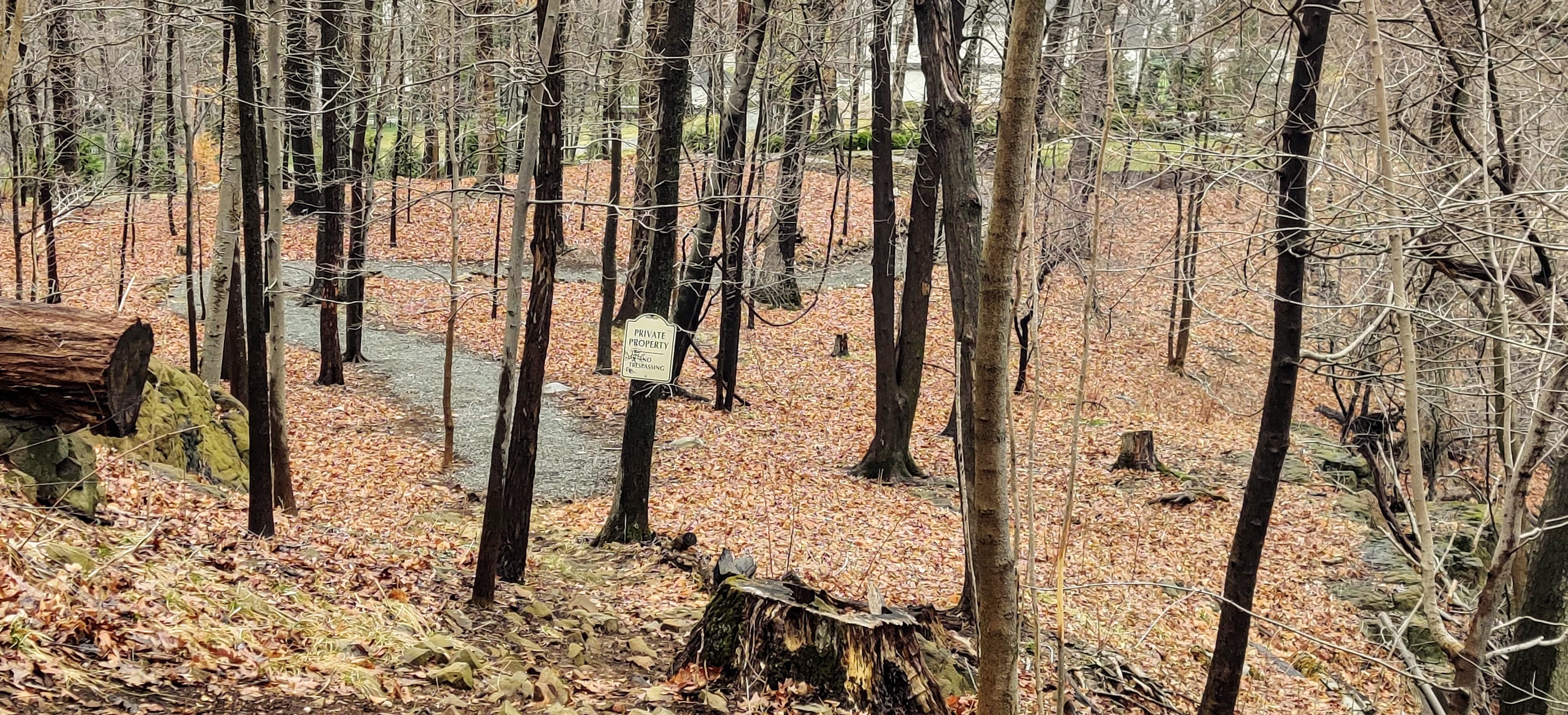
Everett had called High Mountain his home for nearly two decades, so when he saw the sign that read NO TRESPASSING – PRIVATE PATH he studied it as if it were a lump on his testicles. The woods were as familiar as his body, and he explored both daily, to keep abreast of any changes. That’s how death crept up on you.
Everett hadn’t watched television in while, but he remembered scoffing at a commercial imploring people to palpate their groins, because when he was in the company of men, they hadn’t been able to go more than a few minutes without adjusting their tackle, scratching them, or referring to them in some manner. It wasn’t the reason he had chosen the solitude of living in the woods, but it was adjacent. He was better when he wasn’t around people.
He walked up and touched the sign. He hadn’t been to this corner of High Mountain in a while—it covered a thousand acres of rocky, difficult-to-develop land in flood-prone Passaic County, an unlikely valley gouged out of the Watchung mountain chain by glacial determination—home to a basalt valley of jagged spires that had captured the imagination of H.P. Lovecraft, who modeled his Mountains of Madness after the desolate landscape, and the ecological anomaly of a small swamp atop a squat turret that was technically a mountain, and brought the occasional naturalist who wanted to witness such a thing.
He couldn’t cover the acreage every week, much less every day, and some corners he avoided because they bordered a golf course that separated the reservation from the interstate, or slowly melted into the well-groomed back yards of middle-class families who wanted a big house secluded by woods but didn’t mind proximity to Paterson or a flood every five years or so that turned the lawns into mud puddles and made them begrudgingly thankful for the sump pump in the cellar.
This corner was closer to the mountain that gave the reserve its name, on the side where you could get a view of Manhattan at night, a sparkling pirate ship of light. He avoided the peak because it was popular, and a fire pit of small boulders built by former students who were Everett’s parents’ age got a lot of use when night sky was clear and the mosquitoes weren’t bad. In the beginning he’d cleaned up their trash but it was a Sisphyean task, a term he knew because he browsed the university library with a key and an alarm code from the head janitor.
Everett couldn’t get a job in maintenance because of his record, but the head janitor hadn’t cared. Everett had a black seal license and minded the boilers when the janitor went to Florida every winter. He’d died of a heart attack dancing on a cruise ship in a white tuxedo with a retired librarian two years prior, but Everett didn’t know, and the key still worked, so if he had known, he wouldn’t care. He knew how to avoid security and he had one of the janitor’s uniforms, so nothing had changed.
But this corner had changed. The trail he was on—a tributary of a path the Lenape had first blazed when they landscaped the land for hunting, which was widened by colonists and trod by Revolutionary soldiers—ended abruptly at the sign, and turned into a neatly groomed path afterward. The trees had been thinned.
He scolded himself for not hearing the chainsaws, but pocketed as they were in the suburbs, the sound of leaf-blowers and machinery was near-constant from spring to early winter.
Through the trees he spotted a house.
The developers had thinned the trees last, to hide the building of the mansion from the dog walkers and student hikers who frequented the trails that hugged the perimeter, and who might complain, or even get the Sierra Club lawyers to file an injunction. Once High Mountain’s natural oddities became known, the land was vaguely protected by societies of hikers and environmentalists who had their hands full fending developers off of the remaining green space in the Garden State, and apparently they had been distracted.
The house was a large divided ranch that clung to the mountainside like several smaller dwellings, all topped with solar panels and windowed with hazy shaded glass. He breathed slowly as he studied it.
How had they cut off the Lenape Trail? It blazed across New Jersey from Liberty Park to Pennsylvania. He’d met an old guy trying to walk the whole thing, who’d told him all about it, while Everett looked over his head and made polite grunts when he was expected to talk. He wondered if the guy had ever finished.
He looked up the ridgeline. An aged sycamore had fallen on the blazed yellow trail, and instead of cutting through it, the trail keepers had blazed a shortcut that guided you away from the original path. He bushwhacked to the stump and saw the cuts. The tree hadn’t fallen on its own. Small new shoots rose from the stump, trying to feed sun to the dying taproot. It had been a good tree. A hundred feet tall back when he was a teenager. He took a KaBar hunting knife from his belt and plunged it into the dead wood, gouging a hole.
Looked at the blade, shiny from use. And sheathed it.
Using it felt good, but always led to trouble.
He kicked uphill through the brush to find the old trail, huffing like an angry buck deer until he emerged in a small clearing. This place always calmed him.
A hidden crest with a view few knew about, with an oval between tree boughs that framed New York City like a cameo in a locket. He would sit here, look through the boughs at the City he could never visit, and let the peace of the woods relax him.
His bench was gone.
The private trail ended with a bulge, like the bulb of a thermometer, where his redwood bench had been. The grass was groomed, and two wrought iron chairs now faced the cliff. He gripped an arm rest and tugged. They didn’t budge. He reared and kicked the back of a chair. His boot resounded off the metal but the chair legs didn’t lift an inch. They were likely buried deep with a concrete slab to hold them in place.
He gripped the metal seatback and glared at the house.
With a small pair of folding binoculars forgotten by a birder after a yearly migratory bird count, he studied the building. New construction, but made in the English Village like the others in the rich man’s hills, where the only barrier to entry was money.
A small electric car in the driveway. Movement in a dog run along the side of the house. A few ugly poles with lights, security cameras. A ventilated shed that likely held a generator, a barbecue grill the size of a midget locomotive.
Everett studied the windows, looking for faces. He knew what an indecent exposure charge got you in Passaic County, when you looked and smelled like he did. A stay in the jail until the pub-def got to you and explained to the judge that charging a fine you couldn’t pay was a waste of time, and by the time you got back to the secluded hut you’d built, animals had lost their fear and eaten through your hard-earned provisions.
He crept downhill, and once he was sure no one watched, he pulled down the front of his track pants and pissed on the perforated steel pole of the sign, painting up and down.
Marking his territory.
-*-
II. Landowners
Olivia smiled at the jagged spires of Manhattan through the trees. She and Kevin left the City a month ago, and she never thought she’d acclimate to life away from it, much less so quickly. She thought seeing it out the window would be like glimpsing a photo of a lost loved one. But that was the thing: you never saw New York when you lived in it. You saw New Jersey hidden behind the treeline of the Palisades if you lived on the Upper West Side, or the towering skyscrapers looming here and there, if you chose Brooklyn. Once you got over the ignominy of living in Jersey, the seclusion and quiet were quite pleasant, and you were a short hired car ride away from everything that mattered.
They’d chosen the area because it had been an affluent commuter suburb for so long that the Times had dubbed it ‘Park Slope West.’ She’d come up with a fear of suburbs. Her mother and father had fled one in Illinois when her mom was pregnant with her, after a campaign of flat tires, dog shit on door handles, and finally books of matches in their mailbox left them afraid to sleep at night lest they wake up on fire. Liv and Kevin were not shunned in their new home, but they got looks.
Not nasty ones, but friendly ones, which were exhausting. The quiet, wide-eyed smiles of sheltered people, like they had spotted a rare animal on a nature excursion. A smile to themselves for not being racist, for living in a town that was so accepting. Kevin didn’t get it.
She’d tried to explain that those smiles came with an expectation of gratitude.
For what? He’d asked. For allowing them to live here.
He said she was putting thoughts in people’s heads, and she let it go, because she knew it would go nowhere. He’d grown up nearby in a more crowded but similarly affluent suburb where he said his school was ‘like the United Nations.’ And it was true, they were as rich as diplomats and just as diverse, and the only black American family were the children of West Point graduates who literally did work at the United Nations. Liv’s parents were teachers. She went to Princeton on a scholarship, and people like Kevin’s friends assumed “her people” all went to college for free, and got in because of Affirmative Action, and never let her forget it.
What had sold her wasn’t the view or the privacy, but that when they walked the town’s quaint little main drag, she met a black woman who owned a boutique. She was pretty sure she was a lesbian, not that it mattered, except to know that she owned the business herself and it wasn’t a busy-work gift from a white hedge fund manager husband, which was what Kevin’s work friends assumed of her. Even the wives wondered why she kept her agency when she didn’t have to work. And blanched when she said Kevin was thinking of retiring to take up fly fishing.
He wasn’t, and her earnings were half his high seven figures with bonus, but he could if he wanted to.
She wished he wanted to.
Her clients hadn’t even noticed the move; she had the designer replicate the view of her office from her desktop camera and kept Schroeder in his dog run, which she watched from an app on her phone.
She and Kevin had argued about fencing the yard; to him it went against the whole point of negotiating a land buy from the county that abutted the reservation, away from the schlocky suburban developments around the golf course. He said his great-grandparents lived on a country club, and it felt too much like where old people went to die.
But the mass of the woods behind the house—even with a hundred yards cleared and sodded with a lush hybrid grass that looked wild but felt like angel food cake underfoot—felt ominous, ready to swallow them up. They hiked it in new Merrill boots before Kevin made the deal with the County Executive, a quarter-point off the pension fund’s management fee in exchange for an easement that permitted one more dwelling on the leeward side of High Mountain, against the demands of the local NIMBY groups who complained that rainfall cascaded down the mountainside and flooded yards and basements downhill.
Well, does it? she’d asked.
Kevin gave her the toothy grin that he gave to clients. “They knew their houses were at the bottom of the mountain when they bought them,” he said, and squeezed her triceps, massaging them and her pride. No lunch lady arms on her. “Shit rolls downhill.”
So their private drive was carved up the mountainside, and Kevin used its high grade to justify buying a hulking SUV with all wheel drive in case it snowed. She convinced him to get the hybrid, and commuted every day, which she said went against the whole point of leaving the City, but he couldn’t work remotely like she did, he insisted. His salary depended on handshakes.
Meetings over, Liv freed Schroeder from the dog run and let the purebred standard poodle bound up and lick her face. Her baby loved his big yard, and crossed it with long strides, like his mama in her lululemons and sandals, to the manicured gravel trail that led into the woods.
The bench up there had been built as an Eagle Scout project by a boy whose name had faded from the plaque, and the viewpoint was on public land. A hefty donation to the nonprofit who groomed and kept the trails had convinced them to divert the trail. Now it was their private spot for watching the sun rise.
Not that they had. It was too cold in the morning. They clinked champagne flutes and swatted mosquitoes to celebrate their new home, and hadn’t used the chairs since. Kevin had inquired about the mosquito problem, and learned there was a swamp on the mountain. Who’d heard of such a thing? And that it was protected.
Wednesday afternoons were for golf, but Kevin had texted that he would be home with a case of bleach to take care of the mosquito problem.
Schroeder sniffed the pole at the end of the gravel path and raised his leg.
“No!” She tugged at his collar, but he would not be moved.
An entire forest to piss and shit in, and he had to do it on their land.
Their land.
They were landowners now, Kevin said. The closest thing to a title of nobility in the United States, her mother had said. You had to own land to vote once. Or not be owned. And Kevin said some of their neighbors believed it should be that way again.
The landowning requirement. After all, did a renter have skin in the game? They were vagabonds. They could up and leave at a whim, carrying their ‘Irish luggage,’ Kevin said with a smile.
Not knowing that her parents had fled Illinois with everything they owned stuffed into trash bags in the back of a Volvo wagon.
She followed Schroeder up the trail. He sniffed around their chairs and hiked his leg.
“No!” This time she pulled him away by his collar. He growled at the spot. What had gotten into him?
There were deer in the woods, and Schroeder liked to chase them. And neighbors talked of bears, but hadn’t seen one. Kevin joked about buying a hunting rifle for safety, but she’d drawn the line. He’d started that Hemingway shit before they signed the papers, and she cut it in the bud. Fly fishing was one thing. She wasn’t living in a house with heads mounted on the walls, and the only shooting of animals her husband would be doing was with a camera. She’d bought him a pro Leica body and a set of lenses, but all he’d photographed so far was herself and Schroeder, posed against the cameo view of Manhattan, to announce their move on Instagram.
She tugged Schroeder toward the trail, but he didn’t budge. He pointed his muzzle at the house. Kevin wasn’t due back for an hour. She clipped the leash to his collar and commanded him to heel. No hike today, then. She’d put an hour in on the Peloton.
-*-
III. The Lost Son
Kevin downshifted into low even though he didn’t need it to haul the truck up the hill. It felt good to have more than he needed. Prepared.
He had stocked the cellar pantry with dry goods, and had taken to counting how long they could go without having to buy toilet paper or Icelandic mineral water. Olivia had drawn the line at a deep freeze. They had groceries and meal kits delivered, and he had signed them up with a dairy delivery service, a milkman, like in the old days. They even brought fresh steaks for the grill. He was still getting the hang of it, making a hot side and a cool side, but it was good to be learning something necessary.
They’d been digesting a seven-course tasting menu with two other couples when Aria, who had taken up knitting, asked what the rest of them could do if the power grid collapsed. Her husband Gerry had installed a natural-gas-fed house generator in their place upstate because he slept with a hose up his nose, and snored like a buzzsaw when the power went out.
Noah had a gun vault, ever since he started watching zombie apocalypse shows, and they all joked about holing up at his place, and he said they should sharpen up their résumés with survival skills. He winked after pregnant pause, and Kevin had trouble sleeping that night. Olivia teased him about it, but he had felt lacking ever since, and had decided he would chop their own wood for the winter. The trees they’d cut to clear their yard had been cut into stumps, and he bought a Norwegian wood ax that Men’s Journal rated highly, a pair of hand-sewn leather work gloves so he wouldn’t get calluses, and spent an hour each evening chopping wood and stacking it behind the garage. It was a better workout that his personal trainer gave him, and he felt like a woodsman. He settled down with a craft beer or crystal snifter of scotch and Olivia called him her lumberjack.
He liked that.
No time to chop wood and carry water today. He liked that saying, and wished they could dig a well so he could do it. He unloaded the case of bleach from the back of the truck. The dog run was empty, so Liv was out on the trail. Maybe he could surprise her on the way back. He changed into his Vineyard Vines hoodie and Bonobo track pants, loaded four bottles of bleach into the tech-startup branded backpack he’d gotten at the Javits Center, and headed downhill to catch the red trail, which according to the trail maps, led to the swamp.
Maybe this was the swamp where Jimmy Hoffa was buried. Who heard of a swamp on a mountain? The fucking county executive didn’t mention it of course. Now it needled at Kevin, that the greaseball had gotten something over on him. No wonder this had gone through so easily. That and the infestation of deer, which carried ticks with Lyme disease, which clustered in this corner of the county. They stood at the side of the road and stared at you, not even skittish. He thought about hitting one and strapping it across the hood of the truck like a trophy, but felt woozy at the thought of skinning it in the backyard. He’d never been blooded as a child. His father would stomp on the brakes to avoid hitting a squirrel—a tree rat!—and Kevin made up for it by eating wild game whenever it was offered.
He adjusted his pack. Catbirds screamed at him from the trees. Checked his phone. He must have missed the cutoff that led uphill to the swamp. He hated backtracking, wasted steps. A thin path switchbacked through a few pillars of basalt. He trudged through, ducking branches. He would sweep himself down for ticks when he got home.
Olivia would be happy when they could drink wine and enjoy their view without smelling like bug spray. She liked the results, as long as she didn’t have to share the guilt. Kevin had no guilt about it. In fact, he’d been angry that people got to use his vista for months while the trail was diverted. A crease-faced woman with a bird’s nest of hair had the balls to knock on their door and bitch him out about it. Said it wasn’t neighborly. Liv had been walking the dog, and he was three IPAs into a sixer while he played Xbox with some old college bros, and he asked here where the apple pie was, if people were so neighborly around here. Weren’t you supposed to welcome newcomers with a pie or a cake, instead of busting their balls? He told her he was planning to give neighbors access through their gate—which he wasn’t—and now she wasn’t invited.
She left without a word, but he ran the argument through his head often, and was sure he’d won.
He stopped for a rest. He was in great shape, but the slope was steep. He checked the trail map he’d downloaded against his maps app on the phone, but it spun like it did when it couldn’t get a GPS signal. The swamp had to be to his right. The brush was sparse, so he bushwhacked toward the ridge, where he thought he heard frogs or crickets, and squeezed through two lichen-speckled boulders.
Inside the little hollow was a stone living room. The basalt had been stacked into a ring of chairs, with jagged backs and flat seats around a fire pit charred black, a bowl of gray ash with blackened glass shards and blistered cans. A flat stone on one side, like a butcher block or a grill. He snapped pictures with his phone. No signal. He tucked it into his back pocket. This had to be a secret spot where kids from the local college got high and partied. But it was a haul from the campus. He followed another path out, tripped and skidded downhill, and found himself on the orange blazed trail to the swamp. He jogged up, breaking a sweat. The trees thinned into punks and cattails, and he swatted away gnats and mosquitos. The trail ended in a smelly marsh of lily pads in tea-stained water. Tiny frogs rippled the water as they jumped out of his way.
He dumped the pack and uncapped the first bottle of bleach. He couldn’t wait to tell Olivia about the Stoner-henge he’d found. She wouldn’t be into it, but his buddies would, cooking kebabs over open flame. He could taste it over the sharp scent of bleach that cut the methane funk of the swamp.
“No!” The hoarse scream made Kevin turn, but he saw no one. Shit. Boned. Was it the bird-nest lady?
What could they do, give him a fine? He upended the bottle and shook the bleach out into the swamp.
“Just performing some mosquito control,” he said, grinning.
A shape burst through the weeds and barreled him into the muck. Knees crushed his chest, he flailed and choked on bleach and swamp water.
Everett roared atop the man and gripped the old Randall knife his father had given him when he’d joined the Indian Guides. He’d sharpened it so much it barely held its shape, but it still cut like a razor, and he even shaved with it. He had wanted to plunge it into the man dumping bleach, but years in Overlook psychiatric hospital had filed down his impulses. He kept it in its sheath and chucked the half-empty bleach bottle onto land.
The man dry-heaved into the swamp water. Everett plucked his phone from his pocket and skipped it like a stone into the middle of the swamp. Then he pounded the man between the shoulders. Once he was sure the man wasn’t drowning, he gathered the bottle and the man’s pack, and bushwhacked to his cave. Normally he would burn the interloper’s trash in the fire pit, but he’d tracked the man through the stone circle, and the living room he’d built was no longer safe. He would bury the bleach on high ground where it could never enter the water table.
He moved a low-slung branch and belly-crawled under a fallen bough that hid his living place, far off-trail on the leeward side, lost in a tangle of old growth. Beneath his tarp, he squatted on the pile of faded throw pillows scavenged from when the college kids left their dorms and discarded their nesting material and hugged his knees, rocking himself.
Everett squeezed the finger-grooved handle of the knife for relief. It had taken the place of snapping the rubber band on his wrist. The teenager he’d cut all those years ago had survived minus one lung. His father used his position to have Everett committed, and at Overlook Asylum he stayed until his family passed and donated their land to the county. When state took over the asylum, it was found that he should have been released when he was twenty-one, and the doctors weaned him off his medicine, gave him a bag of a hundred thick rubber bands, and released him on his own recognizance. Having nowhere to go, the maintenance man took kindly on him and taught him how to mind the boilers, let him sleep in the boiler room, and wander the forests his family had once owned.
When the asylum closed, he made friends with the maintenance men he found smoking at the college and the golf course, performed chores for them on the sly in trade for cash and the college’s food scrip, which could be used at takeout joints and bodegas within so many miles of the school, to supplement the rabbits and squirrels he caught in snares, and the perch, suckers, and sunfish that he sometimes caught in the pools of the stream.
Now he sat rocking, remembering how men had hunted him in this forest years ago, after he’d found the sick boy touching himself over the yowling, staked animal spreadeagled and burning.
It had been a cat or a rabbit, you could not tell. Then the knife was in his hand, thrusting like the needle of his nanny’s sewing machine. He tried to save the animal with his first aid kit. When it died, he wanted to gut the gasping boy like a fish, but he didn’t. He carried him to the bench he’d built and dressed his wounds. Built a drag litter and brought him to the nearest house, expecting a hero’s welcome.
His father had never raised a hand to him before. Everett ran into the woods and lasted two weeks, before a policeman caught him raiding a dumpster and lured him with half an Italian sub sandwich and a can of Chocolate Cow.
Now he had supplies, and a hiding place no one had found for decades. But he knew men. They would find him and lock him in a tiny room that smelled of medicine and he’d never chew a birch tree root that tasted like root beer, or smell wild onions under his feet again.
He unsheathed the Randall knife and stared at the dull gray blade.
Or he could get to the house before the Bleach Man did.
-*-
IV. Good People
Olivia smelled the bleach on the wind and followed it around to the front of the house, where the bottles littered their doorstep like fat bowling pins.
What the hell?
Kevin’s truck was parked in their circular drive with the doors open. Schroeder barked and circled it. She felt a flutter of fear and called him to her side. The dog obeyed, and she patted his side.
Kevin made a big deal about never locking the doors of his truck because “now they didn’t have to.”
Apparently they did.
The maroon leather seats were soaked with bleach. She reached for her phone, but remembered she’d left it inside. That was the whole point of a nature walk. Escape.
She hadn’t locked the door or armed the alarm. Oh, she had the first few days, but Kevin had plied her with his smile and unlocked it, put the keys on the credenza, and walked away like it was a dare. And there’d been a thrill to it, with anxiety nipping at the back of her neck with every step they took away from the door.
She’d made him set the security cam app on their phones to notify them when the motion sensor went off, but after a family of deer learned that Schroeder didn’t have free roam, they set it off every night at dusk, and they’d disabled it. The system recorded every motion, and they showed off their deer to friends.
She couldn’t even make a fist around her keys. They were on the credenza.
She stared at the front door like the maw of a dark alley.
“Kevin?” she called his name several times.
The keys weren’t in the truck, but the trunk lifted when she pressed the button. In the tire well she found a puny lug wrench. Its weight felt comforting. She walked around the back of the house and whistled for Schroeder to follow.
He wasn’t distracted by scent like he’d been at the benches. She took that as a a sign that the interloper—maybe that crazy lady with the bird’s-nest hair—had pulled their prank and turned tail. Her instinct was to yank the back door open and press the panic button on the security panel inside, but felt foolish. And she’d never called the police in her life, not even when her shared apartment had been burglarized through the window by the fire escape. None of them had renter’s insurance. She left that to her white girl roommate, who whined that they said there was nothing they could do, even when she traced her stolen iPad and pointed to the wide circle over the projects where it last pinged its location. There was a hint of accusation there, and she’d moved out to a sublet as soon as she could.
She wasn’t calling the white suburb police without Kevin here. Schroeder barked as she reached for the knob. She turned in time to see him bounding up the trail.
“Schroeder!”
She gripped the tire iron.
Kevin burst from the woods, red-faced and muddy, ignoring the dog’s yips for attention. “Call the police. Some wacko attacked me. I lost my phone.”
“Are you OK?” She hugged him. His clothes were soaked and smelled of must and bleach.
He kept his arms at his sides, livid with humiliation. “I’m fine. Give me your phone.”
“It’s inside.”
He marched to the door. “This motherfucker is going to jail.”
“Wait!”
He rattled the doorknob then jerked it and kicked the door. “What the fuck! Did you lock us out?”
She set her jaw. “I said to wait.”
“What’s that in your hand?”
She held up the tire iron. “There are bleach bottles all over the front step. Someone was here.”
He took it from her.
The front door was also locked.
Kevin shouldered it. Both doors were reinforced oak. He swore and dug around the lock plate with the tire iron, but found no purchase. He kicked the bleach bottles. “Fuck!”
Schroeder barked and chased one.
“Kevin! What if he’s inside?”
He held out the tire iron. “Lock yourself in my truck.”
“It’s soaked in bleach, Kevin. Listen to me for five seconds.”
“Stop yelling!”
“I have not even raised my voice. Let’s be smart about this. Walk to a neighbor’s house and have them call the police. And a locksmith.”
That’s what Kevin’s father would do. Always handing off responsibilities. The podcasts Kevin listened to on his commute eschewed such behavior as emasculation. And she’d suggested hiding a key outside. He said it was silly, if they weren’t locking the doors anyway.
A window scraped open.
Olivia’s phone skidded across the asphalt. The face was smashed. An angry spiderweb, like a windshield after a fatal accident.
No face appeared in the kitchen window. Just a black hole.
“You crazy motherfucker!” Kevin shouted. “You’re going to jail!” Schroeder barked along with him.
“Shut up.” Something was wrapped around the phone with a thick rubber band, the ones she saved from grocery deliveries. She bent to pick it up.
“What’s that say? What does he want?”
The paper was torn from an art book. On it, a drawing was scrawled in marker. Two chairs and a bright sun.
Kevin scrunched his face like a baby about to scream. “Is that what this is about? The bench? It’s gone. And now so are you. We wanted to live and let live! We’re good people!”
“Don’t antagonize him.”
“Fuck this guy. He’s a little shit.” Kevin had seen the scrawny fucker before he ran. Short, with sunken cheeks, and a long scraggly beard. Shit brown eyes.
He took the tire iron to the wooden shed—painted to look like a barn—and pried off the padlock with a shriek of splintering wood. Olivia watched in silence. He took the Gransfors Bruks wood ax from the pegboard and walked to the back door.
It sunk an inch with the first swing. He wrenched the ax side to side, and swung again.
“Kevin! Are you out of your mind?”
He put several divots into the solid oak construction, then took a breath. “He’s in our house.”
“I know! That’s why we should leave and call the police.”
A rear window scraped open.
“You better leave!” Kevin shouted. He held up the ax. “I’m—”
A crumpled piece of paper around a ball hit the grass.
Another page, wrapped around a piece of decorative fruit. She unwrapped it.
It was a childish scrawl of a house on fire.
Kevin’s lip trembled, but he had no retort. Neither of them could run to a neighbor before the house was in flames.
Olivia put her hand over his mouth. “Didn’t you tell me you loved dealing with someone who’s angry? You’re the angry one here.”
She stroked Kevin’s face, feverish red with anger, and rubbed the back of his neck. “Promise me you’ll let me talk.” His lips parted and she put a finger to them. “Uninterrupted.”
He nodded and sat down on the stump where he chopped wood, letting the ax dangle, then fall. Schroeder placed his paws on his lap and he let the dog lick his face. “Hey buddy.”
This drawing was rushed. The first one had been neater, made by an eager, if unpracticed hand.
“Hello up there,” she called. “What do you want?”
Nothing.
“Maybe he’s illiterate.”
“Hush.”
Three knocks on the back door.
Kevin picked up the ax. She waved him away. She knocked on the door three times in return. “You’re the Trail Guy, aren’t you?”
One knock.
“What’s your name?”
A piece of paper torn from a cookbook appeared under the door. Everett.
“Hi, Everett. What do you want?”
The paper pulled back. Then a cough, and a reedy voice. “Why did you take my bench?”
He was the Eagle Scout. She’d taken a photo of the plaque on her phone. It was thirty years old and faded. The bench was weathered but had lasted that long.
“It was overgrown,” she said. “We didn’t know anyone used it.”
“I made it for my dad.” The voice was scratchy, but thick with emotion. It made Olivia think of a television puppeteer she’d seen once, who had a voice too fragile for a person, but comforted you when it came out of a face made of raggedy blue felt.
“I’m sorry, Everett. We didn’t know.”
Kevin smirked, then looked back at Schroeder.
“You know that bleach doesn’t belong in a swamp.”
He had her there. “We’re sorry, Ev—”
“You’re not sorry. You will be, if I burn this house down.”
“Yes, yes we will. But you don’t have to do that. Won’t that hurt your forest?”
“Don’t talk to me like a child. You think you’re good people. But you’re not.” His voice became reedy again. “Good people don’t poison a rare swamp. And they don’t steal land for themselves.”
“Good people don’t burn down people’s houses, Everett.” She said it without raising her voice.
“I’m not a good person.”
“You want us to give it back?” Kevin said. “Is that it? Take it. We don’t go up there anyway.” Olivia glared, and he held up a hand. She sucked her teeth. She would have stayed in Manhattan, if not for that damn view.
A long pause. “Really?”
Kevin pointed at Olivia, then made a running motion with his fingers, and held an imaginary phone to his ear.
She nodded, and clapped for Schroeder to follow her.
“Just go. I’ll get those chairs torn out.” Kevin stepped close to the door. “You can build a new bench. I’ve got a shed full of tools. OK?”
“I… I’d like that. I’m gonna unlock the door.”
Kevin held the tire iron behind his back, and opened the door. The hallway was empty. “Everett?”
“You must think I’m pretty stupid!” The voice echoed from inside. “I’ve got all your liquor bottles on your stove with a bunch of papers. And I’m gonna turn the burners on!”
Kevin stepped inside and slipped on the cooking oil coating the tiles. His knee hit the floor hard. He yelped.
Olivia froze and turned back. Kevin was sprawled on the floor.
Everett sprayed him with their kitchen fire extinguisher and Kevin thrashed blindly. The red canister glanced off Kevin’s head and Olivia screamed. Everett brought the extinguisher down like a hammer, and her throat burned with a howl. Schroeder bolted for him and disappeared in a cloud of white spray. Then whimpered.
The hairy madman stepped out holding a knife.
Olivia ran down the driveway, losing her sandals. The rough asphalt burned her feet. Everett jogged down the brambles to cut her off. She ran back into the woods and slipped on the chunky rocks that littered the hill and it was done. Like the needle of a sewing machine. Her lies made it easy.
Dragging her back to the house was hard.
The dog was harder.
Everett watched the house burn from the vista, taking apart their chairs with the ax and throwing the pieces over the ridge. If they came for him, so be it.
When he had been an Indian Guide, his group visited the Ramapough-Lenape people to see a pow-wow. Before then, Native Americans had been only in books, or crying in that commercial. One of the old women told them how the Ford paint factory poisoned the land, and it was killing them. But if they left their mountain, they couldn’t fight for it.
His heart clenched like a fist. He and the Guides were playing at being something they only imagined, but these people were real.
Their group leader apologized for what white men did to their land.
She held up a hand. No one owns the earth.
Her words spoke the love Everett felt when he walked in the forest alone. As they got into the leader’s van, he ran from the group and told her that he wanted to live with them.
She touched his face with a weathered hand. You have to go home. But if I tell you a secret, will you promise to be a good person?
His chin hammered his chest with nods.
You do live with us.
Everett had tried to be good, he told himself.
But sometimes good people did bad things.
-*-*-*-
©2020 Thomas Pluck